

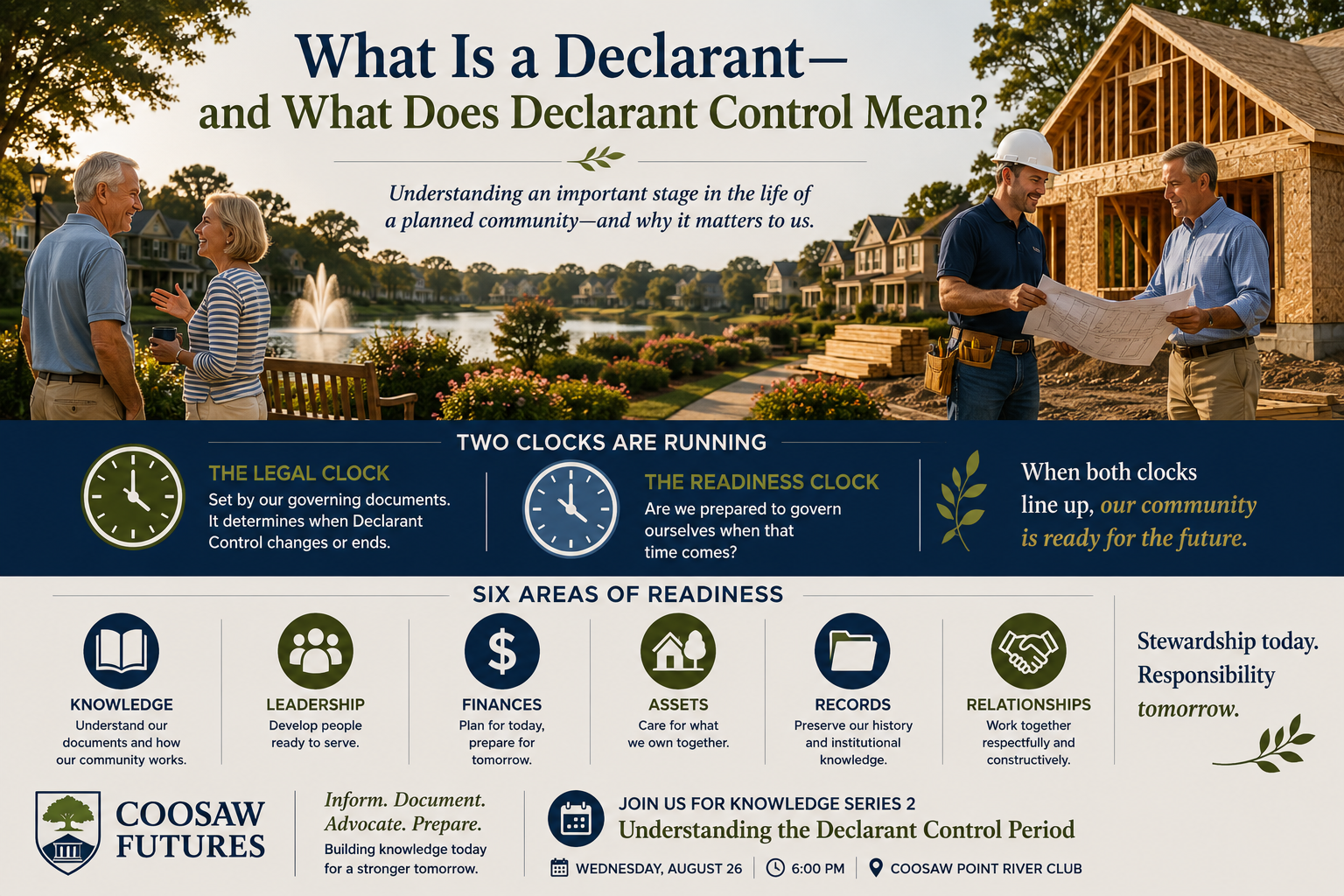
What Is a Declarant—and What Does Declarant Control Mean?
Understanding an important stage in the life of a planned community and why it matters to us.
As we worked through our first Knowledge Series, we spent a fair amount of time looking backward at how Coosaw Point began, how the community was planned, and how decisions made years ago helped shape the community we enjoy today.
For Knowledge Series 2, we are going to move the story forward.
Coosaw Point is still a developing community. And because development is not complete, we remain in what is commonly called the Declarant Control period.
If you have not spent time reading governing documents, the word Declarant may not mean very much. In simple terms, the Declarant is the person or company given certain rights and authority while a planned community is being developed. In our case, that role is currently held by the developer.
That arrangement is not unusual. Planned communities across the country go through some form of developer or Declarant control while they are being built.
What I think is more important for us to understand is what this period means and how a community uses the time it has before that period eventually ends.
Two Clocks Are Running
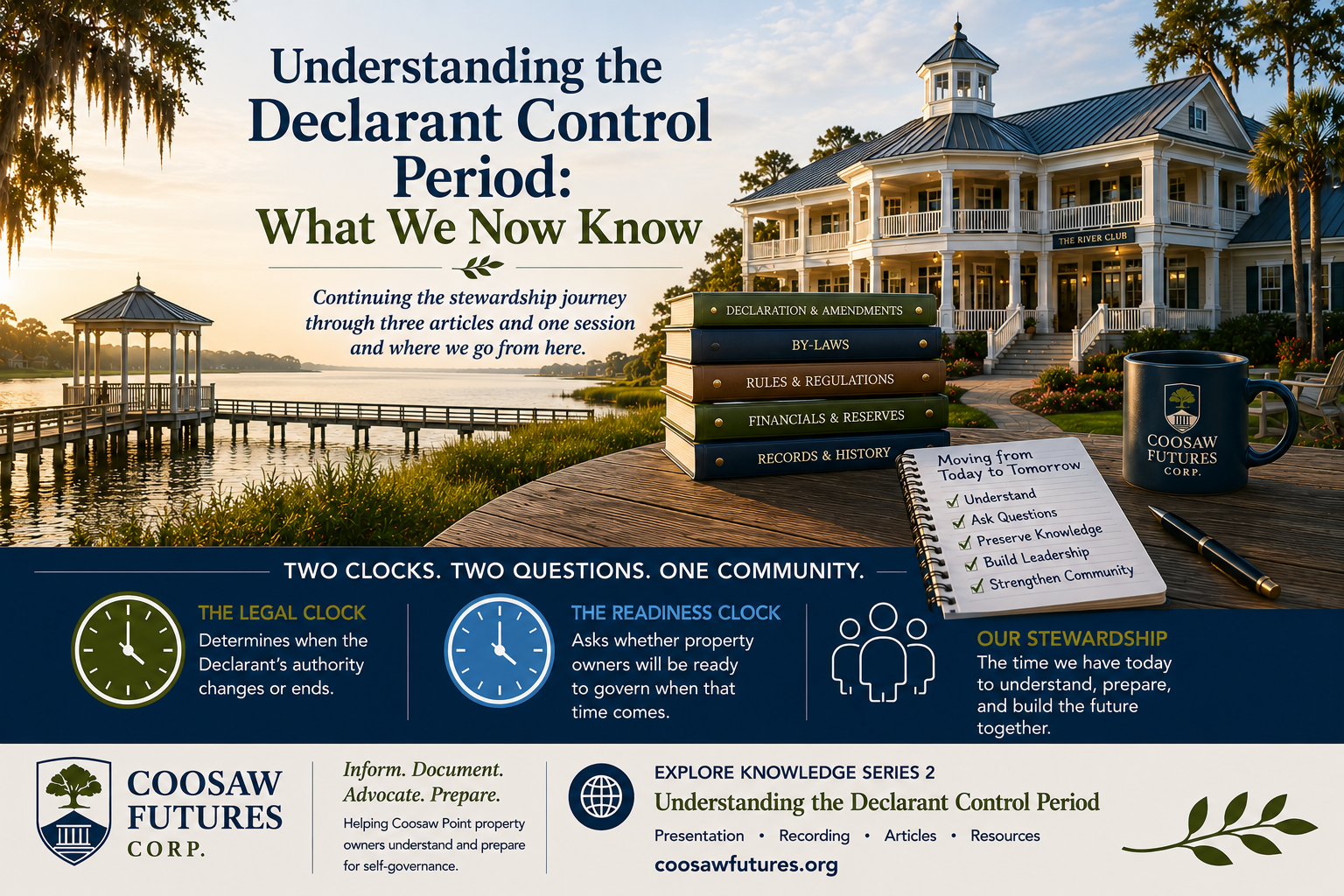
One of the more useful ideas I have found in looking at how other communities have moved from developer control to owner governance is that there are really two clocks running at the same time. The first is the legal clock. The legal clock is established primarily by the community’s governing documents. It determines when the Declarant’s authority changes or ends and when property owners assume greater responsibility for governing the association. There is another just as important clock. I would call it the readiness clock. The readiness clock asks a different question: When the community becomes responsible for governing itself, will property owners actually be prepared to do it?
Those two clocks do not necessarily run at the same speed. A community can reach the legal point of turnover without having enough owners who understand its finances, governing documents, common assets, contracts, or long-term obligations. Or a community can begin preparing much earlier. Where owners serve on committees, learn how the association operates, become familiar with the finances, preserve important records, and gradually develop people willing and able to assume leadership roles. When turnover eventually arrives, the community is not beginning from scratch.
That’s an important distinction.
Knowing when Declarant Control ends matters. Understanding what we will eventually be responsible for matters just as much.
What Should a Community Be Thinking About?
Research and experience from other community transitions identify several areas that are worth understanding before owner governance begins.
For purposes of our discussion, they are grouped into six:
Knowledge risk: Do property owners understand the governing documents, the association’s structure, and how decisions are made?
Leadership risk: Is there a group of property owners gaining the knowledge and experience necessary to eventually fill all the board and committee positions?
Financial risk: Do assessments, budgets, reserves, and other financial resources reasonably reflect the community’s long-term obligations?
Asset risk: Do we understand the condition and future maintenance needs of the roads, drainage systems, amenities, landscaping, and other common property the association will be responsible for?
Records risk: Are important contracts, warranties, plans, financial records, historical documents, and other institutional knowledge being preserved so they can eventually pass from one group of leaders to another?
Relationship risk: Are we developing the ability to ask questions, discuss differences, and work together constructively when community decisions become our responsibility?
None of these necessarily indicates that something is wrong. They are better understood as areas of readiness, and I think that distinction matters.
The purpose of learning about Declarant Control should not begin with the assumption that there is a problem. It should be to understand how the community works today and what we should be learning and preparing for tomorrow.
Coosaw Point is somewhere along this same path. Our community development continues. The Declarant continues to hold significant rights and responsibilities. Property owners participate in the community, but we do not yet exercise all of the authority that will eventually come with owner governance. It makes Declarant control an especially useful time to learn.
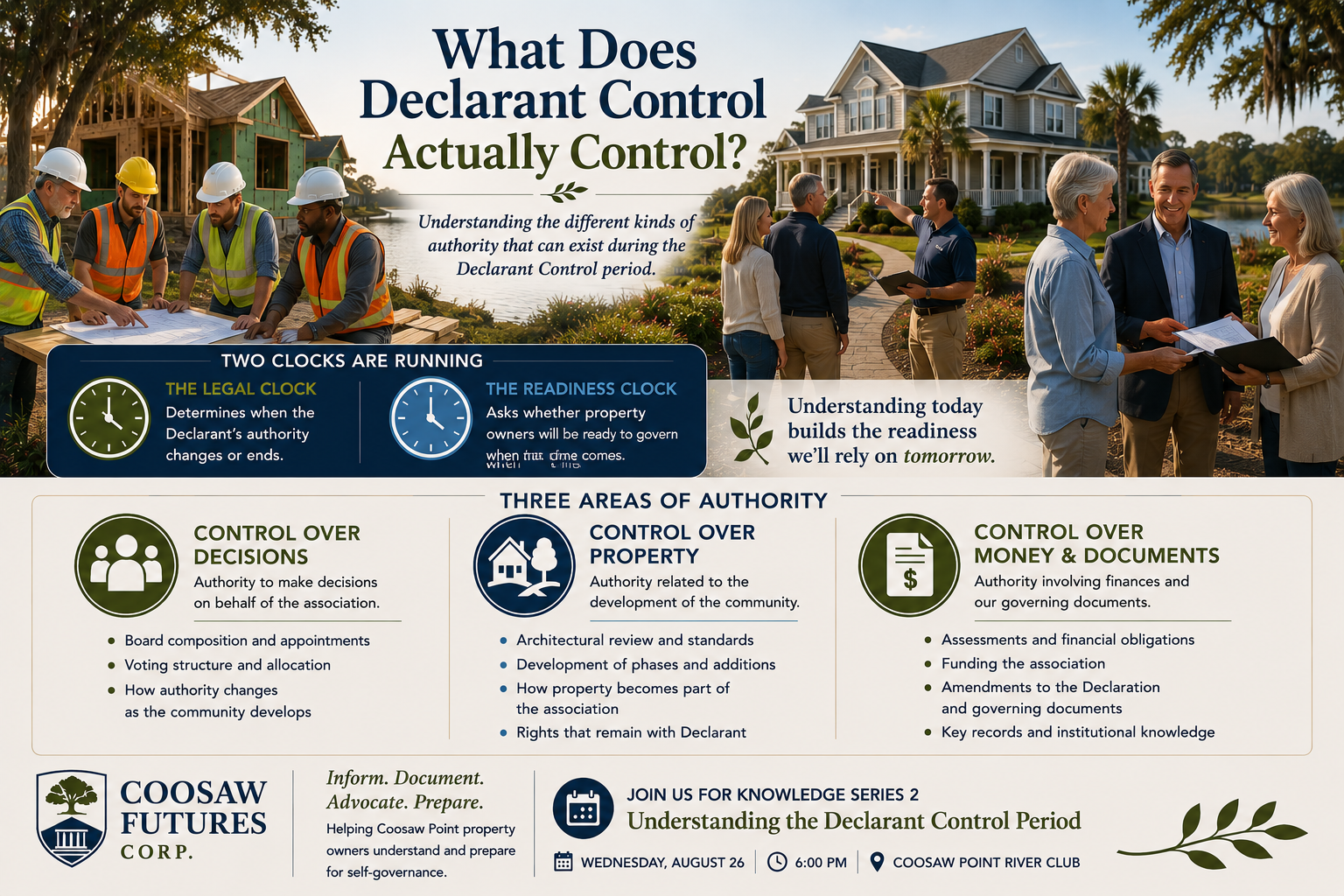
What authority does the Declarant actually have? What authority do property owners have today? What responsibilities belong to the Board? How are decisions made? How are the community’s finances and common assets being prepared for the future? And ultimately, what does our own Declaration say about how Declarant Control ends?
Those are the questions we’ll begin exploring in Knowledge Series 2.
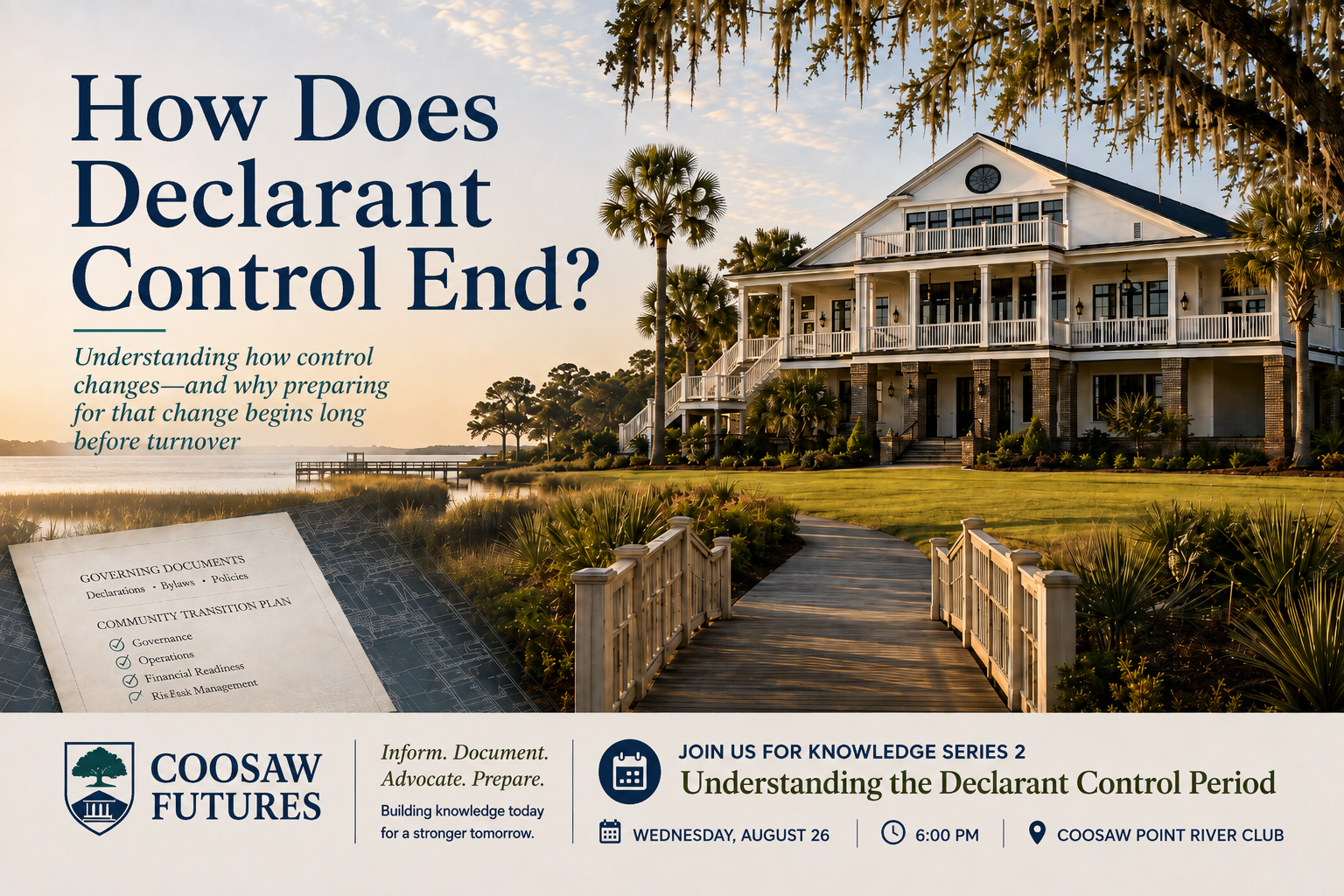
Not because turnover is necessarily imminent, but because preparing for self-governance should not begin the day before it happens. It is something a community can build over time. Perhaps that is the larger opportunity of the Declarant Control period.
We can simply wait for the legal clock to run, or we can use the time to move the readiness clock forward as well.
A Question to Consider
Of the six areas—knowledge, leadership, finances, assets, records, and relationships—which do you think is most important for Coosaw Point property owners to better understand today?
There is no single right answer.
That’s exactly the kind of conversation we hope the Knowledge Series will encourage.
Join us for Session 2 of our Knowledge Series: Understanding the Declarant Control Period, Wednesday, August 26, at 6:00 PM at the Coosaw Point River Club.
We will look more closely at what Declarant status means here at Coosaw Point, what our governing documents say, what South Carolina law does and does not provide, and how all of this relates to the community’s eventual transition to owner governance.
Community Associations Institute Foundation for Community Association Research, Best Practices: Transition from Developer Control (2022) and Transition, Best Practices Report #7 (2003).
Community Associations Institute, Transition of Community Association Control from Developer to Homeowners (Public Policy Statement, adopted 1983, most recently amended 2012).
South Carolina Study Committee on Homeowners Associations, Final Report to the General Assembly (December 18, 2015).
Community Associations Institute Foundation for Community Association Research, Strategic Planning, Best Practices Report #3 (2014).
CAMS Community Association Management Services, CAMS Guides Community Through Excessive Developer Activity.
Rimkus Consulting Group, From Developer Control to Owner Confidence: A Florida Country Club HOA’s Transition Story (May 2026).
W.C. Bunting, The Developer Control Problem: Applying Corporate Fiduciary Standards to Homeowner Associations, Stetson University College of Law Research Paper (January 2026).
Join us for Knowledge Series 2: Understanding the Declarant Control Period
📅 Wednesday, August 26
🕕 6:00 PM
📍 Coosaw Point River Club
Coosaw Futures, Corp. is an independent, owner-formed nonprofit dedicated to Informing, Documenting, Advocating, and Preparing Coosaw Point property owners through education, historical preservation, and constructive civic engagement. Learn more at coosawfutures.org.

Leave a Reply
You must be logged in to post a comment.