

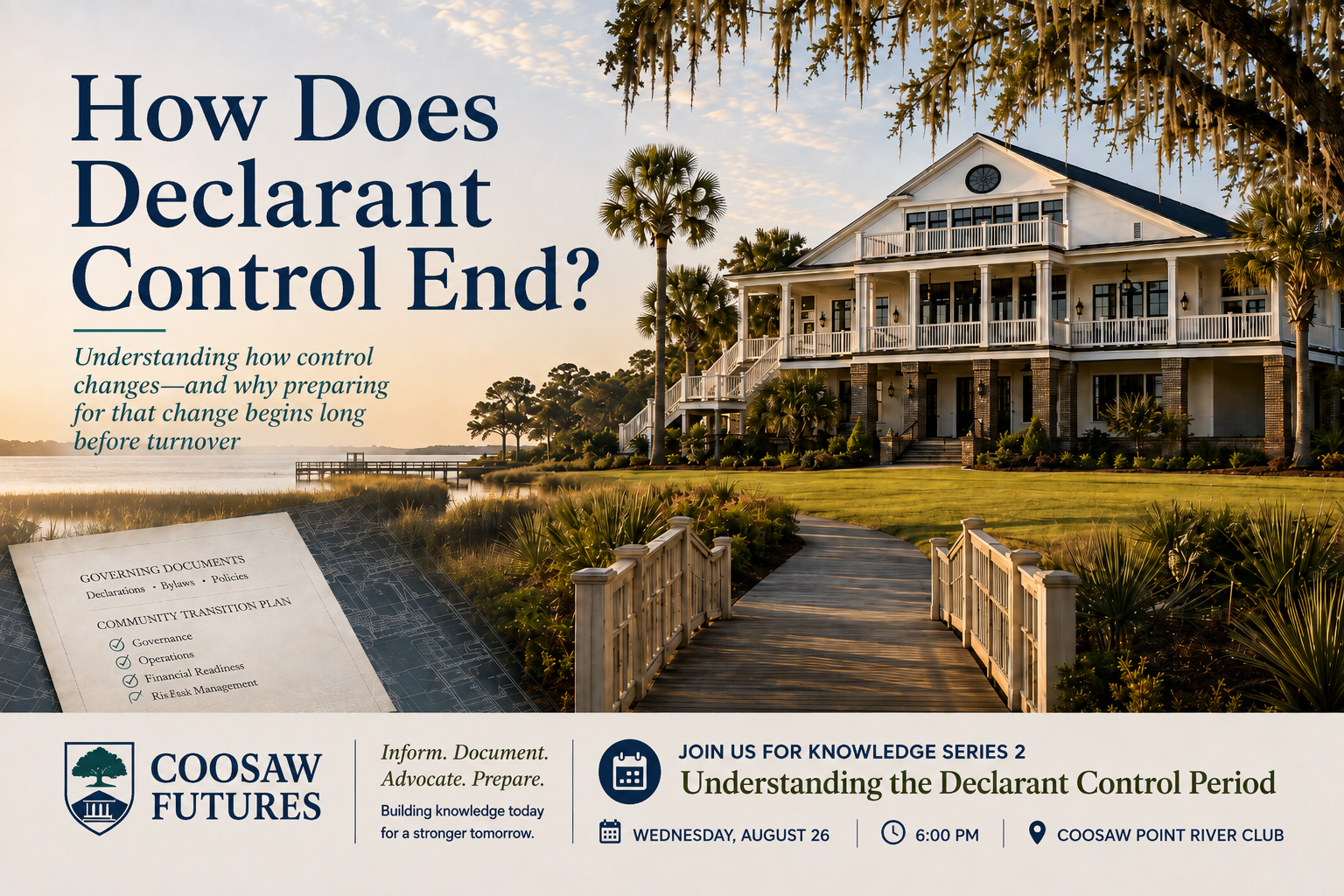
How Does Declarant Control End?
Understanding how control changes—and why preparing for that change begins long before turnover
In our first two Knowledge Series 2 articles, we have been working our way through the Declarant Control period one piece at a time. We started with what a Declarant is and introduced the idea that two clocks are running during this stage of a community’s development: a legal clock and a readiness clock. Then we looked at what Declarant Control can involve; the different kinds of authority over decisions, property, finances, and governing documents. It brings us to the question property owners may be most curious about: How does Declarant Control actually end? The answer begins in a familiar place. The governing documents.
There Isn’t One Universal Turnover Date
It would certainly be easier if every planned community followed the same rule. They do not. Across planned communities, governing documents commonly provide several ways for Declarant Control to end. Three of the most common are:
A build-out or sales threshold: Control changes after a specified percentage or number of homes or lots have been sold.
A time-based backstop: The governing documents establish a date or number of years after which certain Declarant rights end, regardless of whether development is complete.
Voluntary surrender: The Declarant may have the ability to give up certain rights before it is otherwise required to do so.
Not every community has all three. And even when two communities use similar provisions, the details can be quite different. Declarations can also be amended over time. That is why a general statement such as, “Declarant Control ends when 75 percent of the homes are sold,” may be true somewhere without being true here. To understand when and how Declarant Control ends at Coosaw Point, we must look at Coosaw Point’s own recorded governing documents. We will do this during Knowledge Series 2. However, knowing the legal answer raises another question. What happens the day after?
The Legal Clock Is Only Part of the Story
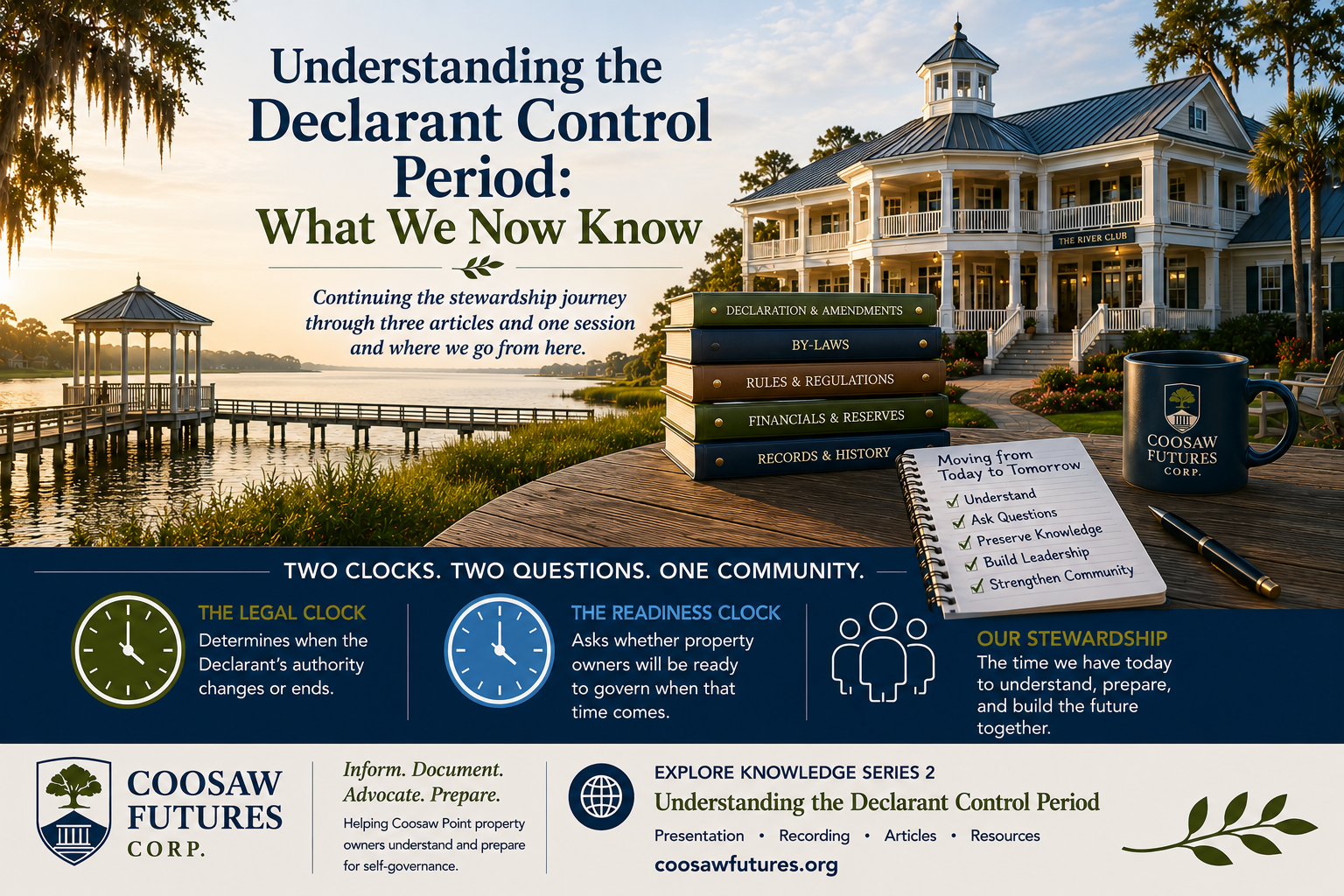
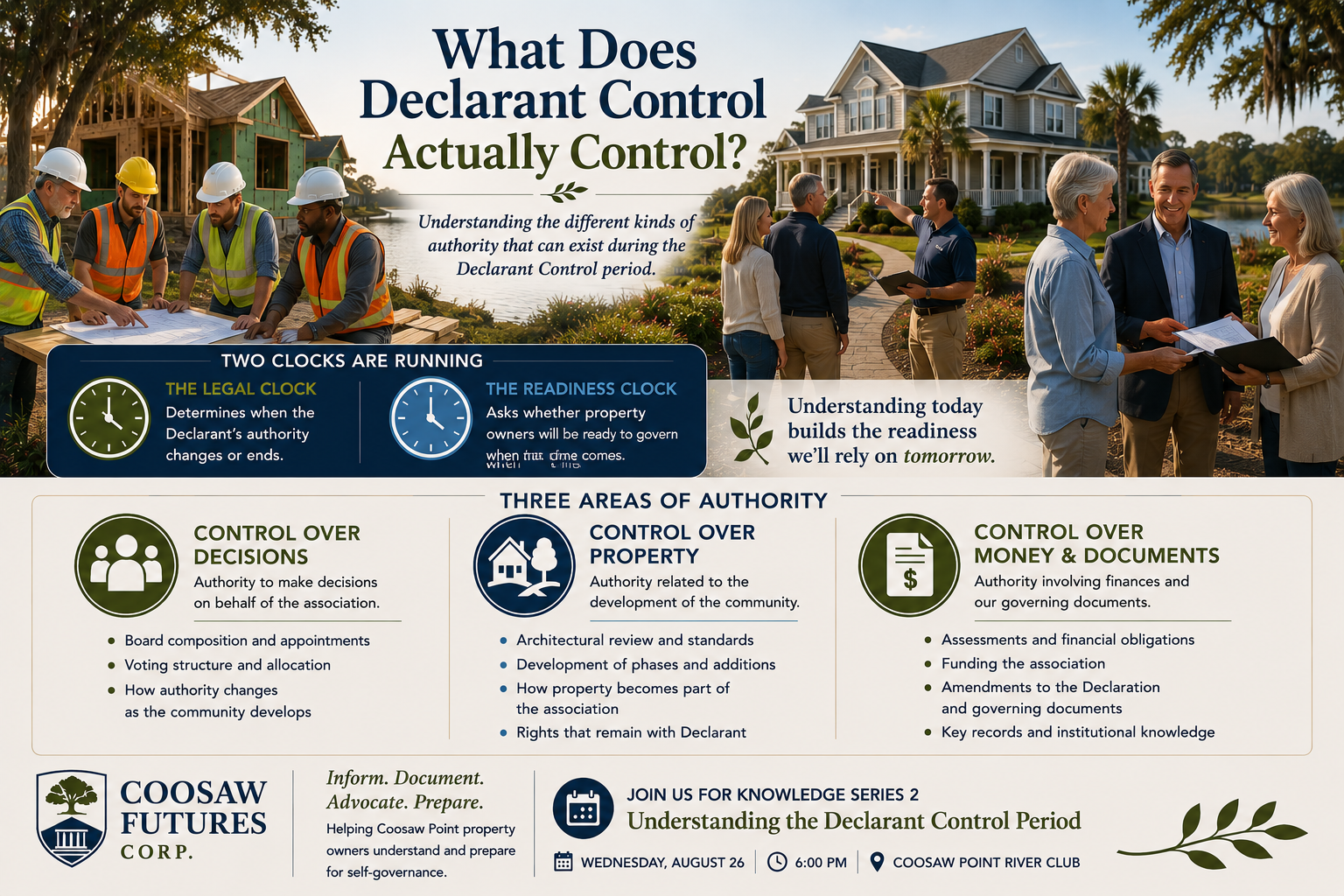
We have used the idea of two clocks throughout this series because I think it helps explain something that can otherwise get lost in a discussion about turnover. The legal clock tells us when authority changes. The readiness clock asks whether the community is prepared for the responsibilities that come with that change. Those are not the same question. Looking at the experiences of other communities helps illustrate the difference.
Two Communities, Two Experiences
Ford’s Colony is a large golf-resort community in Williamsburg, Virginia. According to a case study published by the Foundation for Community Association Research, its governing documents called for a fully owner-elected board after 75 percent of its approximately 3,250 units had been sold. Fortunately, preparation did not begin when the community reached that threshold. It began years earlier.
Starting in 1990, an advisory board of elected homeowners began participating in the community. Owners were gradually added to the governing board. By 1996, a Strategic Planning Committee was working on community surveys, reviewing governing documents, examining reserves, and identifying important association records. Full transition eventually occurred in 2000. Ten years after the preparation started. The association’s account describes that transition as occurring “without incident.”
Now consider another community. Village at Craig Ranch is a much smaller, 206-home community in North Las Vegas. When its Declarant Control period ended in 1998, its new owner leadership encountered a very different situation. According to the case study, the association had less than $5,000 in reserves, entry gates that had not worked for more than two years, more than $20,000 in unpaid assessments, an outdated reserve study, and a difficult relationship with its management company. The new board then spent the next several years working through those issues, including changing management companies, obtaining a reserve study, and addressing construction-related concerns.
These are two very different communities, so we shouldn’t draw too much from a simple comparison. But they illustrate something worth thinking about. The legal transfer of authority and a community’s readiness to exercise that authority are two different things.
What Does Readiness Look Like?
This is where I think the conversation becomes more useful for Coosaw Point. Readiness does not necessarily mean having every problem solved before turnover. It means understanding what we are eventually going to inherit.
- Do we understand the governing documents?
- Do we understand the community’s finances and reserve needs?
- Do we know what common assets the association owns and what it costs to maintain them?
- Are important contracts, warranties, plans, financial records, and historical documents being preserved?
- Do property owners understand how Board service and community governance work?
- Are people gaining experience today who may be willing to serve tomorrow?
- And perhaps just as importantly, are we learning how to ask difficult questions and work through disagreements constructively?
Those are not questions that need to wait until turnover. In fact, waiting may be the least useful time to begin asking them.
Using the Time We Have
This brings us back to something we said in the first article. Coosaw Point is still in the Declarant Control period. We can look at that simply as a period we’re waiting to end. Or we can look at it as time available to learn. Time to understand our history, our governing documents, our community’s finances and assets. Time to preserve institutional knowledge. Time to develop future community leaders. And time to become more practiced at working through community questions together. None of that changes the Declarant’s authority today. It does something different. It helps prepare property owners for the authority and responsibility they will eventually have themselves.
Bringing the Three Pieces Together
That is really what these first three articles in Knowledge Series 2 have been about.
What is a Declarant?
Understanding why Declarant Control exists and where Coosaw Point is in the development process.
What does Declarant Control actually control?
Understanding the different kinds of authority involved and where those rights come from.
How does Declarant Control end?
Understanding the legal mechanisms that eventually change that authority and recognizing that legal turnover and community readiness don’t necessarily happen at the same time.
Taken together, they give us a framework for the conversation we will have during Session 2.
Not simply: When does Declarant Control end? But also: What should we understand before it does?
A Question to Consider
Which matters more to you right now: knowing exactly when Declarant Control will end at Coosaw Point, or understanding whether we will be prepared when it does?
There is no wrong answer. In fact, we probably need to understand both.
Join us for Session 2 of our Knowledge Series: Understanding the Declarant Control Period, Wednesday, August 26, at 6:00 PM at the Coosaw Point River Club.
We’ll look at what our own Declaration says about how Declarant Control changes and ends at Coosaw Point, where we are in that process today, and what property owners can begin understanding now to help prepare for the responsibilities that eventually come with self-governance.
Sources
Community Associations Institute Foundation for Community Association Research, Transition, Best Practices Report #7 (2003) case study of Ford’s Colony at Williamsburg.
Community Associations Institute Foundation for Community Association Research, Strategic Planning, Best Practices Report #3 (2014) case study of Village at Craig Ranch Homeowners Association.
South Carolina Study Committee on Homeowners Associations, Final Report to the General Assembly (December 18, 2015).
Join us for Knowledge Series 2: Understanding the Declarant Control Period
📅 Wednesday, August 26
🕕 6:00 PM
📍 Coosaw Point River Club
Coosaw Futures, Corp. is an independent, owner-formed nonprofit whose mission is to Inform, Document, Advocate, and Prepare—helping Coosaw Point property owners understand their community and prepare for the responsibilities of self-governance.

Leave a Reply
You must be logged in to post a comment.