

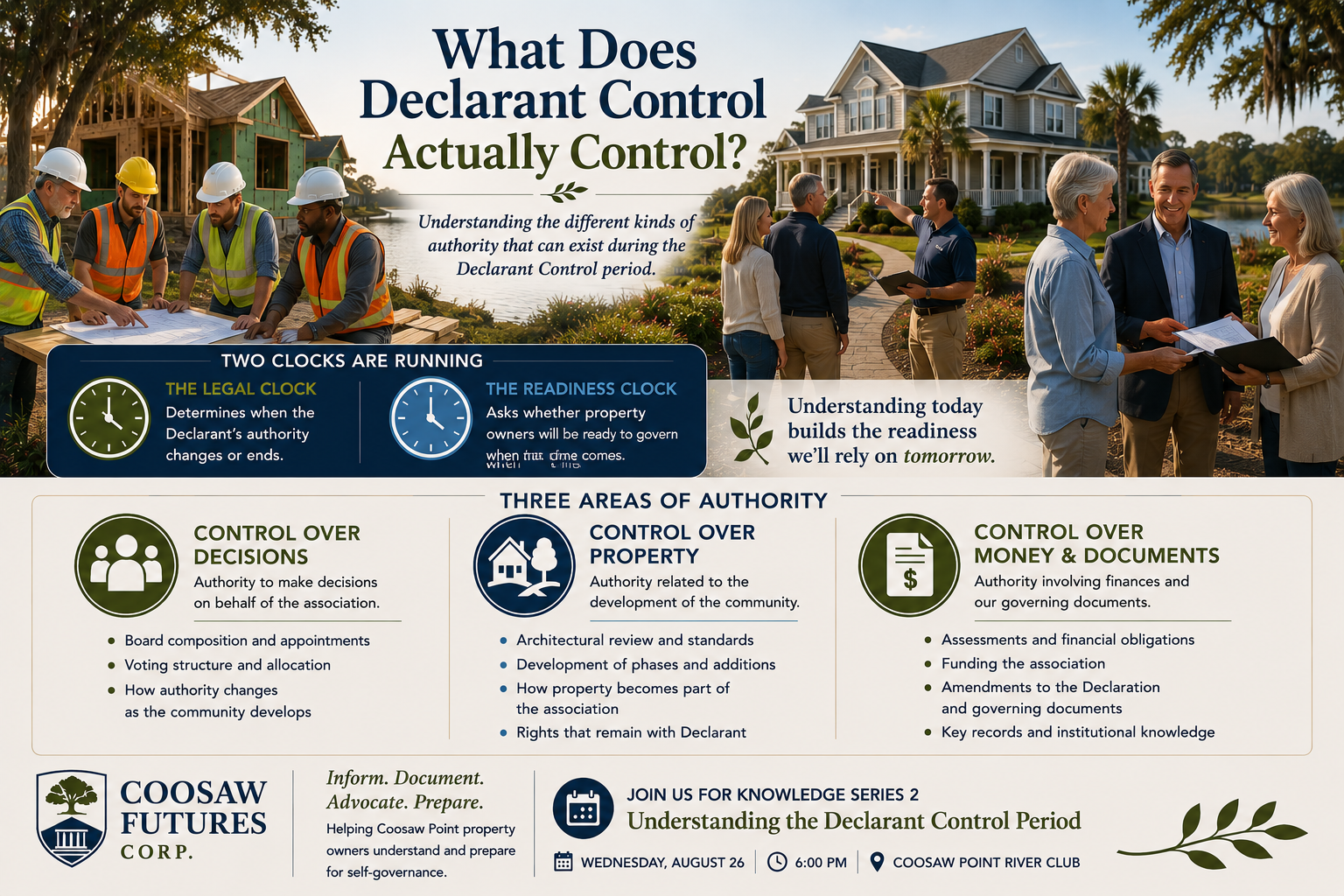
What Does Declarant Control Actually Control?
Understanding the different kinds of authority that can exist during the Declarant Control period
In our first Knowledge Series 2 article, we introduced the idea that two clocks are running during the Declarant Control period. There is a legal clock that determines when the Declarant’s authority changes or ends. And there is a readiness clock that asks whether property owners will understand the community well enough to govern it when that time eventually comes. Before we can really understand either one, there is another question worth asking: What does Declarant Control actually control?
At first, that sounds like it should have a simple answer. It does not.
Declarant Control isn’t a single power that applies equally to everything happening in a community. It is better understood as a collection of specific rights and authorities established through the community’s governing documents and applicable law. For purposes of understanding them, we can group many of those rights into three broad areas: decisions, property, and money and documents.
Control Over Decisions
The first area is probably the one property owners notice most: who has the authority to make decisions on behalf of the association?
During the development period, a Declarant may retain significant authority over the composition of the Board and the voting structure of the association. That can affect questions such as: Who appoints or elects members of the Board? How many Board positions are held by property owners? How are votes allocated between the Declarant and other members of the association? And how does that balance change as the community develops? These are not simply procedural details. They help explain how authority is distributed during different stages of a planned community’s development.
The important point is that the answers do not come simply from the phrase Declarant Control. They come from the governing framework that establishes the Declarant’s specific rights. For Coosaw Point, that means looking at our own Declaration and related governing documents.
Control Over Property
A second area involves the physical development of the community itself. When a developer is still actively building a planned community, it generally needs certain rights that allow it to complete the development plan. Those rights can include things such as architectural review, development standards, and the ability to add additional property or phases to the community. This is where the relationship between the original development plan (remember PUD from Knowledge Series 1) and the governing documents becomes particularly important. As we discussed during Knowledge Series 1, Coosaw Point was not developed one house at a time. It was planned as a community. Our development has occurred in phases over many years, and the Declarant continues to play a significant role in completing that development.
Understanding the authority associated with that role helps us ask better questions. What standards govern new development? Who has authority to interpret and apply those standards? How does additional property become part of the Property Owner Association? And which of those rights remain with the Declarant until development is complete? The answers are found in our governing documents.
Control Over Money and Documents
The third area may be less visible, but it can have some of the greatest long-term significance for the community. It involves financial obligations and our governing documents. During a Declarant Control period, the governing documents may establish different financial rights or obligations for the Declarant while it continues to own property and develop the community. Those provisions can affect how assessments are handled, what financial responsibilities belong to the Declarant, and how the association is funded during the development period. The documents may also give the Declarant certain rights to amend the Declaration or other governing provisions while development continues.
Those are significant authorities. Because they can affect both the community’s finances and the rules under which it operates, they are worth understanding carefully rather than simply assuming what the Declarant can or cannot do.
Why These Categories Matter
It would be easy to turn all of this into a list of provisions to memorize. I do not think that is the real value. The more useful lesson is learning to identify what kind of authority we are actually talking about when a question arises.
If a property owner asks about the composition of the Board, that’s primarily a governance question. If someone asks who approves a new home or architectural change, that’s a property and development question. If the question involves assessments, financial obligations, or amendments to the Declaration, we’re in a different category all together. All three may relate to Declarant Control, but they are not the same question.
That distinction helps us move from: “Can the Declarant do that?”
To a much better set of questions:
- What authority are we talking about?
- Where does that authority come from?
- What do our governing documents actually say?
- Are there limits or conditions on it?
- And does that authority change as the community moves toward owner governance?
This is the kind of framework I think helps property owners become better informed.
It does not begin with the assumption that a particular action is right or wrong. It begins by understanding the structure, gathering the facts, and asking the right questions.
Building the Readiness Clock
This also brings us back to the readiness clock from our first article. Preparing for self-governance is not knowing the date when Declarant Control ends. It is about understanding the responsibilities property owners will eventually inherit.
- Who will make decisions?
- Who will oversee the community’s assets and architectural standards?
- Who will understand the finances?
- Who will know what the governing documents permit?
- Who will preserve enough institutional knowledge so that future Boards aren’t forced to rediscover all of this from the beginning?
Those are owner-governance questions. Learning how those responsibilities are handled today helps prepare us for the day when they become ours.
A Question to Consider
Of these three areas—decisions, property, or money and documents—which do you think property owners understand the least today?
There is no wrong answer.
Each is worth understanding on its own, and together they provide a much clearer picture of what Declarant Control actually means.
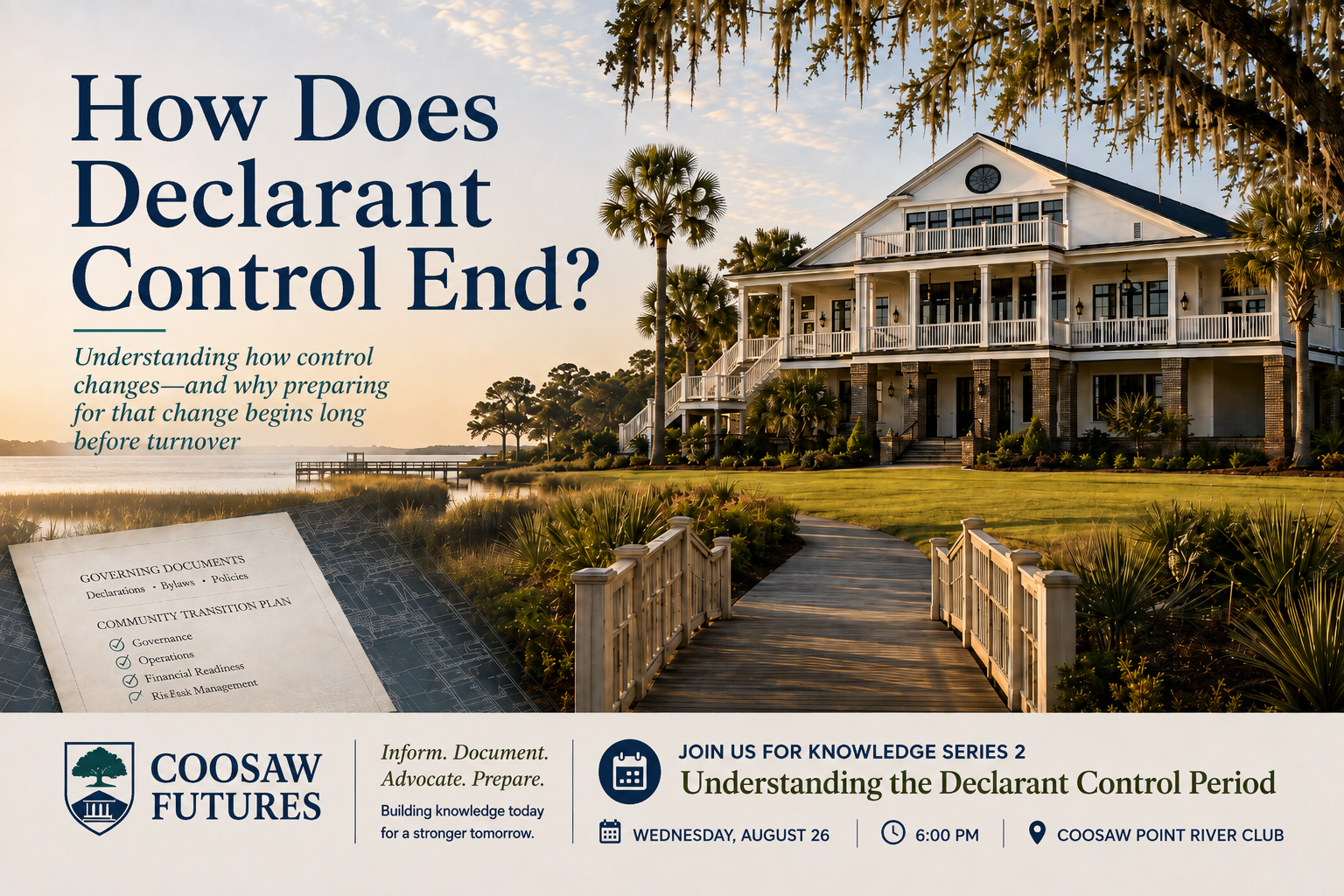
Join us for Session 2 of our Knowledge Series: Understanding the Declarant Control Period, Wednesday, August 26, at 6:00 PM at the Coosaw Point River Club.
We will walk through these areas specifically at Coosaw Point using our own governing documents and South Carolina law to better understand what authority exists, where it comes from, and how it changes over time.
Sources
Community Associations Institute Foundation for Community Association Research, Best Practices: Transition from Developer Control (2022).
South Carolina Nonprofit Corporation Act, S.C. Code Ann. Title 33, Chapter 31.
Join us for Knowledge Series 2: Understanding the Declarant Control Period
📅 Wednesday, August 26
🕕 6:00 PM
📍 Coosaw Point River Club

Leave a Reply
You must be logged in to post a comment.