

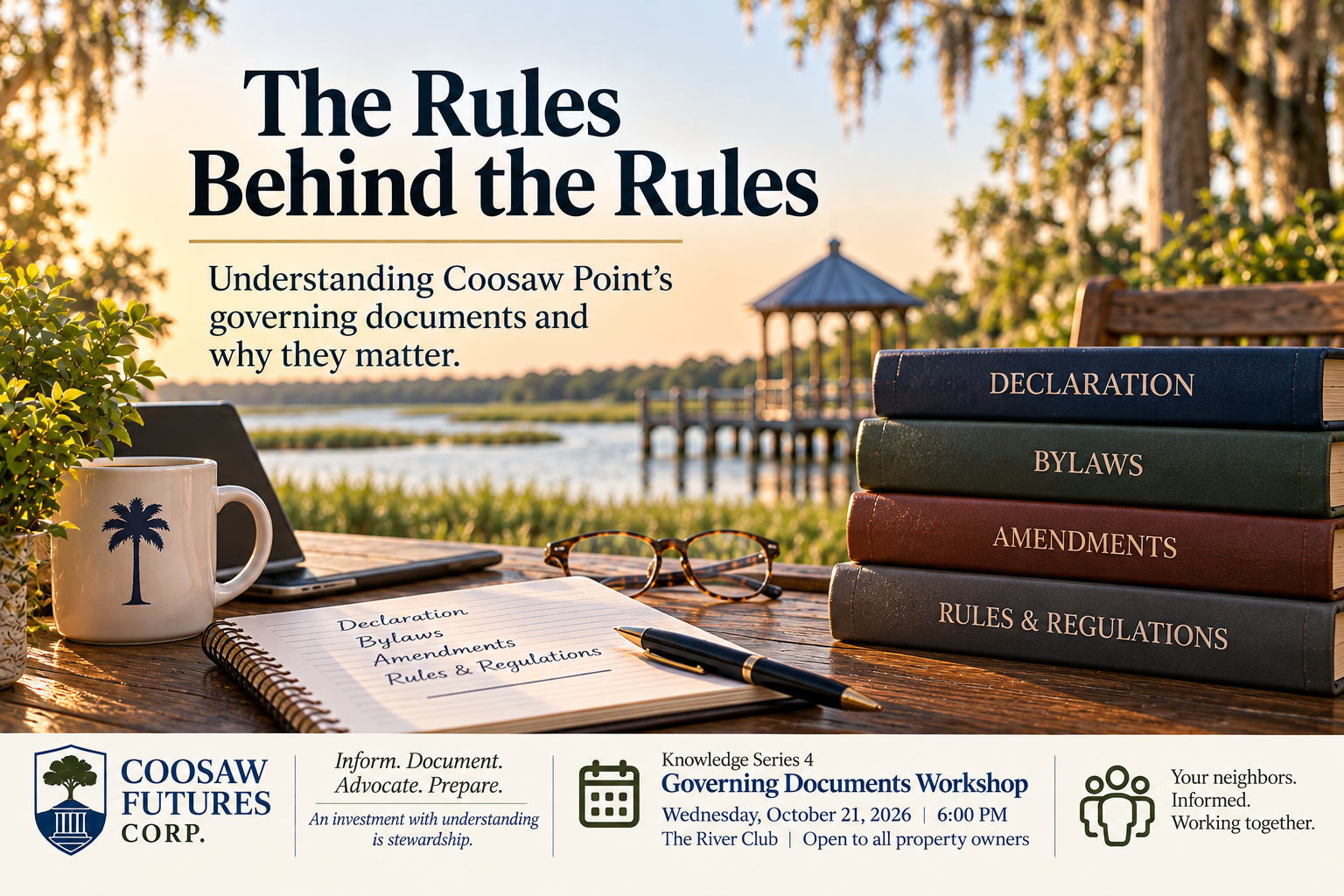
Understanding Coosaw Point’s governing documents and why they matter.
If you have ever tried to answer a question about Coosaw Point by looking through our governing documents, you probably know it isn’t always as simple as finding a single paragraph. There is the Declaration, the Bylaws, amendments made over the years, and the Rules and Regulations. Depending on the question, more than one of those documents may matter.
Most of us first become familiar with these documents when we want to do something with our own property. Can we build a fence? Who approves a change to the house? What are the restrictions? Those are reasonable places to start. But there is another side to the documents that deserves our attention, particularly as we learn more about how Coosaw Point is governed.
They also tell the people responsible for governing the community what they are authorized to do, what they are required to do, and sometimes what they cannot do. That is an important distinction. A community cannot understand its governance by looking only at the rules that apply to property owners.
Words That Carry Different Responsibilities
One thing I’ve learned from working through these documents is how much turns on a few ordinary words. A provision that says the Board ‘shall’ do something generally describes an obligation. When it says the Board ‘may’ do something, it ordinarily allows a choice. And when it says the Board ‘shall not’ do something, it establishes a limit. The full provision and applicable law still matter, but recognizing those differences is a useful way to begin.
Take Bylaws §3.24(b), for example. It directs the Board to exercise its powers fairly and without discrimination and to follow the procedures established in the governing documents. That provision is not about whether a property owner can make a change to a yard. It is about how the Association’s authority is supposed to be exercised.
That doesn’t mean every decision will satisfy every owner. It does mean we have a place to start when we want to understand whether a decision was made within the authority and procedures the documents establish.
A Simple Example: Board Meetings
Board meetings are a good example because most of us have heard about them, but fewer of us have spent much time reading what the Bylaws actually say. Under §3.7, the Board is to meet at least four times during each fiscal year, with at least one meeting each quarter. Section 3.14 says those meetings are open to members, subject to the Bylaws’ provisions for executive sessions and action without a meeting.
It would be easy to hear ‘open meeting’ and assume that every owner has the right to speak or vote at it. But those are different things. The Bylaws permit members to attend; they do not provide a general right for everyone attending to join the Board’s deliberations. There is a separate opportunity to be heard before certain changes to the Rules under Declaration §4.2(a). Knowing the difference helps us understand both the rights we have and the limits of those rights.
There is another practical question. If meetings are open to members, how does an owner find out when and where they will take place? A simple review of the documents identifies requirements for notice to directors, but not a general requirement to send Board meeting notices to all owners. Sharing a meeting calendar may be a sensible practice, even where the documents do not specifically require it. That is the difference between understanding a minimum obligation and discussing how a community might make that obligation more useful.
What About the Record of What Happened?
The same distinction appears when we look at meeting minutes. Bylaws §3.13 directs the Secretary to maintain a minute book of Board meetings, and §4.1 addresses the Secretary’s responsibility for preparing minutes. Section 6.4 provides members with a qualified right to inspect and copy Association records, including Board minutes, at reasonable times for a purpose related to their interest in a Unit (lot or combined lots).
But keeping minutes, allowing inspection, and routinely sending minutes to every property owner are not the same thing. Reviewing the documents finds requirements for the first two, but no general requirement that Board minutes be posted online or emailed to the community. Publishing them could still be a helpful way to keep people informed. We just need to be clear whether we are describing what the documents require or suggesting a practice that might improve communication.
I think this is where some confusion begins. An owner may reasonably want more information than the documents require the Association to distribute automatically. That doesn’t make the request unreasonable. It simply means we should understand whether we’re asking for compliance with an existing duty or encouraging a better way to communicate.
Understanding Comes Before Accountability
We are still in the Declarant Control period, and that affects who appoints directors and how certain decisions are made. It does not, by itself, make the Board’s existing procedures disappear. Those responsibilities remain part of the governing framework unless they are lawfully changed.
When questions arise, it helps to begin with something more specific than ‘the Board should’ or ‘the Board can’t.’ Which document applies? What does it actually say? Is it a requirement, a choice, or a restriction? And what information would help us understand what happened? Sometimes the answer will confirm that a decision was within the Board’s discretion. Sometimes it may raise a fair question about whether a required procedure was followed.
Neither outcome has to begin with a confrontation. It can begin with an informed question. That, to me, is part of what community stewardship means today, long before Coosaw Point reaches self-governance. The governing documents give us a common starting point for understanding both our responsibilities as owners and the responsibilities of those who govern on behalf of the Association.
A Question to Consider
If you wanted to understand how a recent community decision was made, would you know which document to consult first and what records or questions might help you find the answer?
Sources and Further Reading
Coosaw Point Bylaws §§3.7, 3.13–3.15, 3.24(b), 4.1, 6.4 (Beaufort County ROD Book 2275, pp. 2150–2152, 2156–2158); Declaration §§4.2(a), 7.1 (Book 2275, pp. 2082, 2090).
Coosaw Futures, Corp. is an independent, owner-formed nonprofit whose mission is to Inform, Document, Advocate, and Prepare—helping Coosaw Point property owners understand their community and engage constructively as it moves toward eventual self-governance.



Leave a Reply
You must be logged in to post a comment.