

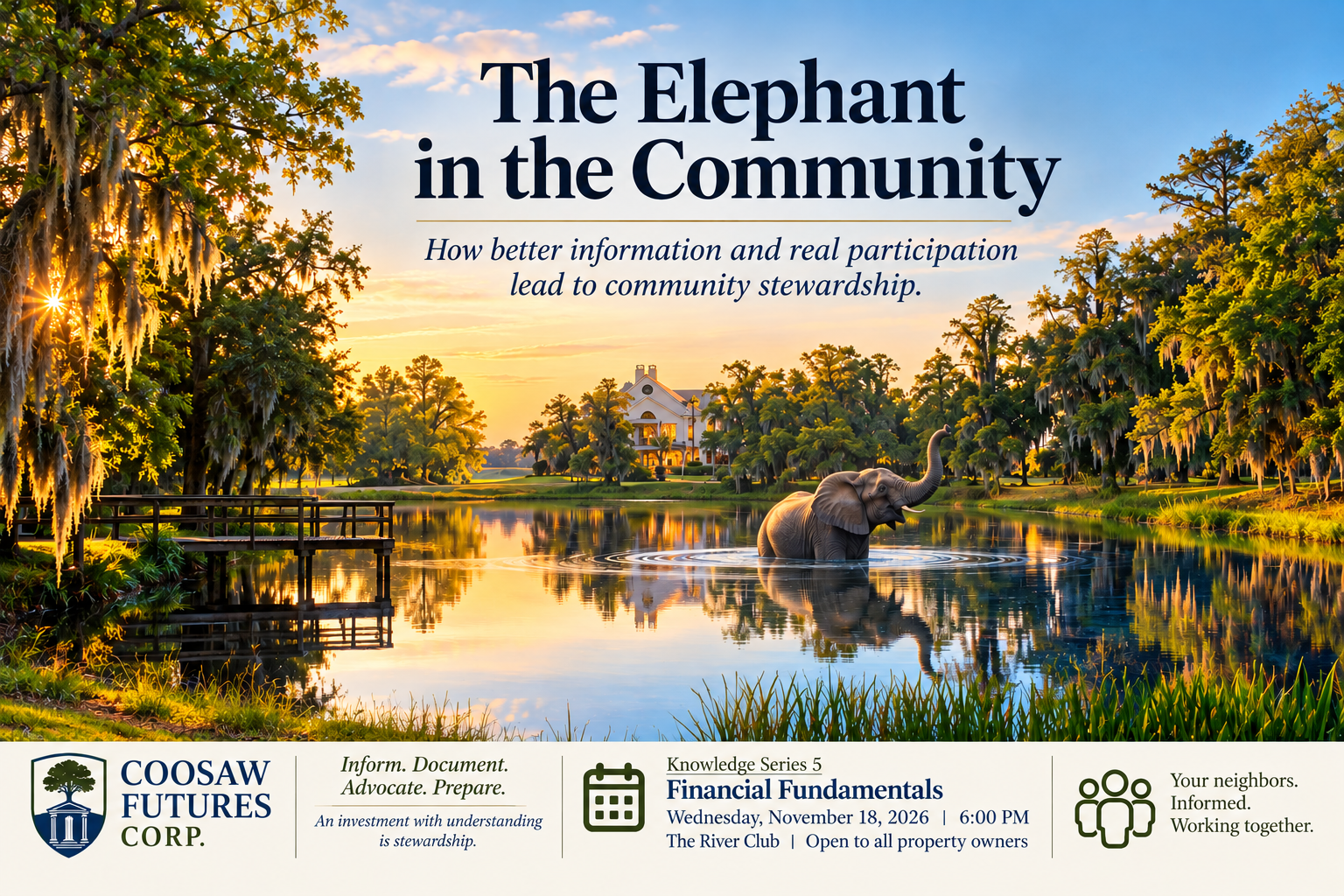
How better information and real participation lead to community stewardship
There’s an old parable about several blind men who encounter an elephant for the first time. Each is asked to describe what an elephant looks like, but each can only examine one part of the animal. One feels the trunk and describes something like a snake. Another touches a leg and believes the elephant resembles a tree. A third feels its side and describes a wall. Still another holds the tail and thinks it must be something like a rope. Each person is describing what they experienced. None is dishonest. But none has enough information to understand the whole elephant.
I’ve thought about that story in relation to how we sometimes talk about our community. One neighbor remembers a decision made years ago. Another recalls a conversation with someone who served on the Board. Someone else has heard an explanation about why something is being done today. Sometimes those accounts are accurate, and sometimes they are incomplete. As they’re repeated through social media, porch conversations, and neighborhood gatherings, the story can take on a life of its own.
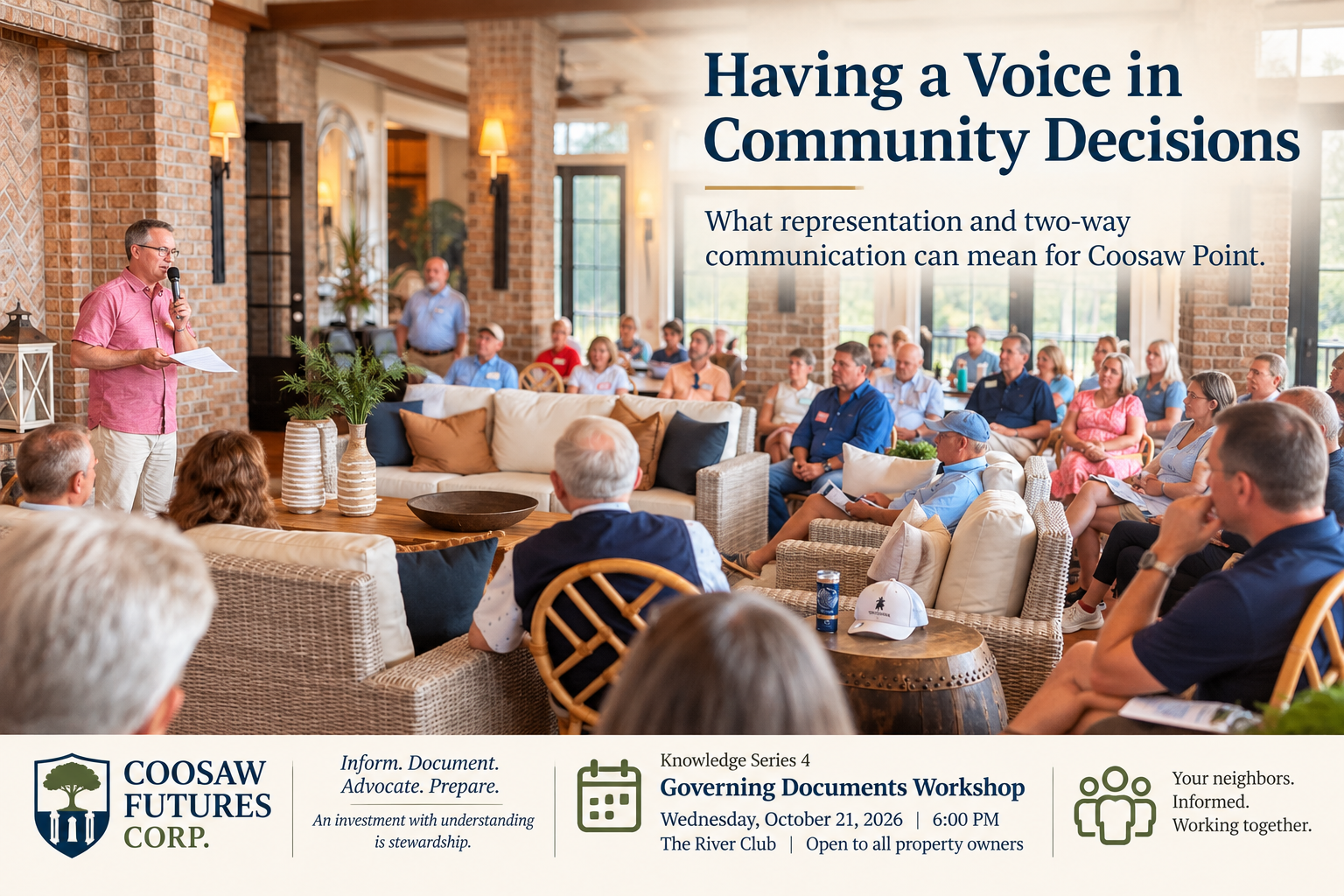
That’s one of the lessons from Knowledge Series 4: understanding how our community is governed takes more than knowing what someone remembers or has been told. It takes knowing where to find what happened, what the governing documents require, and who has the authority to make decisions.
Understanding the Rules Behind the Decisions
The Declaration, By-Laws, Rules and Regulations do more than establish restrictions on what property owners can do. They also describe who has authority to act, the responsibilities that come with it, and the processes some decisions must follow.
When a question arises about a community decision, it’s tempting to begin with whether we agree with the outcome. There are better questions to ask first. Who had the authority to make the decision? What information was considered? Was there a procedure that needed to be followed? Were property owners entitled to notice, a chance to be heard, or access to particular records? And where can we find reliable answers?
Not every disagreement means someone has done something wrong. Boards are expected to make decisions, and those decisions will not always satisfy everyone. But understanding how a decision was reached helps us distinguish between a decision we simply don’t like and one that may deserve further review.
From Understanding an Issue to Addressing It
During our October 21 workshop, participants worked through a hypothetical situation using the governing documents and the responsibilities assigned to different parties. What stood out was how much understanding is needed before deciding what action makes sense. We used a framework that followed six steps:
Issue → Role → Authority → Process → Information → Response
What is the issue? What is acting and in which role? What document gives them authority? What process applies? What information is missing? And only then, what response makes sense?
The exercise wasn’t intended to produce agreement or to suggest that there is always one correct answer. It showed that how we approach an issue can be just as important as the issue itself. Working through the steps may reveal that a concern is based on incomplete information, or it may identify a responsibility or a procedure that deserves closer examination. We don’t have to begin every community concern by deciding who’s right or wrong. We can begin by evaluating the facts, which gives us a better opportunity to address the concern constructively.
When Information Is Incomplete
One of the challenges facing a community like Coosaw Point is that we are still developing. Some property owners remember the earliest years of the community, others arrived during later phases, and some have only recently purchased homes. Each brings a different understanding of the community’s history.
Those perspectives are valuable. But recollections are not always the same as records, and practices followed in the past may not reflect the governing requirements that apply today. Over time, an assumption repeated often enough can begin to sound like an established fact.
There is another side to this. When information about community decisions is difficult to obtain, or when explanations are limited, people naturally try to fill in the gaps. That helps explain why different versions of the same story develop. Good communication is more than publishing an occasional report or announcing a decision after it has been made. It involves making information accessible, explaining the reasoning behind important decisions, and providing reasonable opportunities for questions.
Property owners have a responsibility to seek accurate information. Those governing the Association have obligations under the governing documents and an opportunity to support that understanding through clear, consistent communication. Both are important.
From Conversation to Participation
I’ve also been asked what tangible results these articles and sessions should produce. Coosaw Futures was formed to Inform, Document, Advocate, and Prepare. Those objectives were never intended to end with a collection of articles and presentations. Helping property owners understand an issue is different from property owners becoming involved in addressing it.
The issues that draw the most comment aren’t always the ones that matter most to the community’s future. A proposed change to something we see every day can generate considerable discussion. A decision like the annual budget, which requires understanding of the Association’s operating costs, reserve funding, and the needs of a community still being developed, often draws far less. Both deserve informed consideration, and that is what Knowledge Series 5 is about.
Expressing concern, understanding an issue, and actively participating in its resolution are three different things. Coosaw Futures is an independent organization formed by property owners. We are not part of the POA’s governing structure, and we do not have authority over the Board or Declarant. What we can provide is a place to gather information, understand the governing framework, document concerns, and help neighbors with shared interests find one another. What happens next depends in large part on property owners themselves.
A concern may lead to a request for information. A group of neighbors may decide to develop a recommendation or pursue a formal process available under the governing documents. Sometimes the information we gather may reveal that a decision was reasonable, even if it wasn’t popular. What matters is that the people who care about an issue are willing to participate in what comes next.
That’s part of what I mean by community stewardship: taking enough ownership of the community’s future to understand an issue, consider the available options, and contribute to a constructive outcome.
What Accountability Really Means
Accountability can sound confrontational, but it doesn’t need to be. It begins with understanding what responsibilities exist, who holds them, and how we can determine whether they’re being fulfilled. Sometimes that means asking for an explanation, reviewing a document, or asking those responsible to reconsider a decision. It also means being willing to accept an answer when the facts support it, even if it isn’t the answer we hoped to receive.
There is a difference between saying, ‘I don’t like what happened,’ and being able to explain what happened, what the governing documents provide, and what we believe should be considered next. The second approach creates an opportunity for meaningful dialogue. It also requires something from community leadership. Property owners cannot reasonably be expected to understand every decision if the information necessary to evaluate those decisions is unavailable or difficult to access. An informed community and accountable governance are not competing objectives. They should reinforce one another.
Preparing for the Community We Will Eventually Govern
This matters for a larger reason. Coosaw Point remains in the Declarant Control Period. At Turnover, responsibility for governing the Association will rest with property owners.
When that day comes, we’ll need property owners who understand the governing documents, the Association’s finances, its common assets, and the responsibilities that come with serving on the Board. We’ll also need people willing to listen to neighbors with different perspectives, ask difficult questions, and make decisions that may not always be popular. Those abilities don’t suddenly appear when Declarant Control ends. They develop through the experiences we have today.
Coosaw Futures cannot make that happen on behalf of property owners. We can help provide information, create opportunities for discussion, and support constructive participation. But the commitment to become involved must come from the community itself. Stewardship is something we can practice now, not something we wait to begin at Turnover.
Looking at the Same Elephant
As we conclude Knowledge Series 4, I keep coming back to the elephant. Seeing only part of the picture doesn’t make anyone wrong. But we should be careful about drawing conclusions before we’ve made an effort to understand the whole. Not every concern requires a petition, a formal challenge, or a change in policy. Sometimes the most valuable outcome is simply correcting a misunderstanding or helping neighbors see why a decision was made.
The goal isn’t to make sure everyone sees the elephant exactly the same way. It’s to make sure we’re all looking at the same elephant before deciding what we think about it. An informed community is the foundation. An engaged community is what turns that understanding into stewardship.
A Question to Consider
As we become better informed about how Coosaw Point is governed, what is one area where you believe greater understanding could lead to a meaningful improvement—and what role might property owners play in making that happen?
There are no right or wrong answers. That’s exactly the kind of conversation the Knowledge Series is designed to encourage.
Coosaw Futures, Corp. is an independent, owner-formed nonprofit whose mission is to Inform, Document, Advocate, and Prepare—helping Coosaw Point property owners understand their community and engage constructively as it moves toward eventual self-governance.

Leave a Reply
You must be logged in to post a comment.