

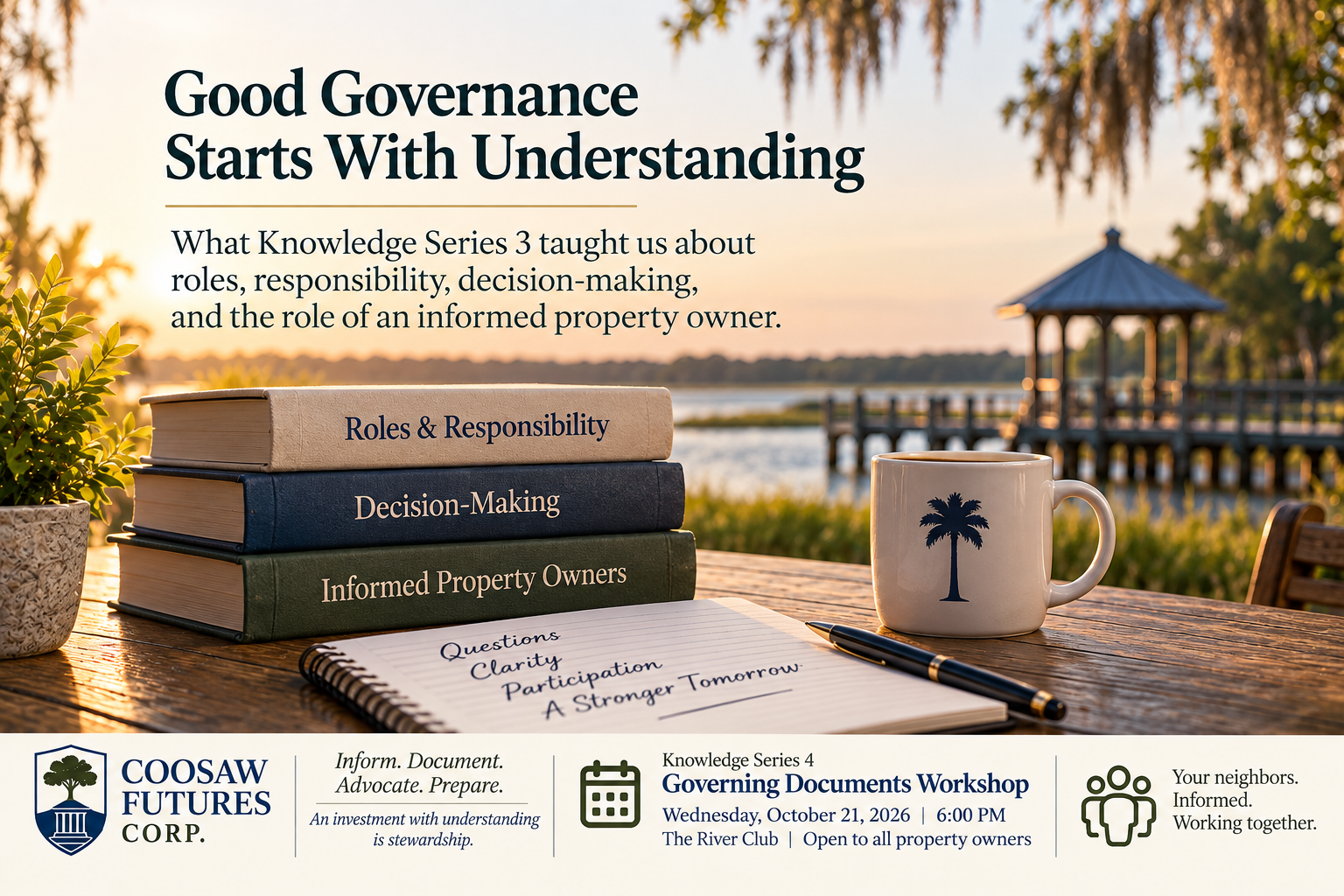
What Knowledge Series 3 taught us about roles, responsibility, decision-making, and the role of an informed property owner
Over the past several weeks, we’ve spent a fair amount of time talking about governance.
Governance can make a relatively simple idea sound more complicated than it needs to be. At its core, governance is about how decisions are made, who has the authority to make them, what responsibilities come with that authority, and how the people affected by those decisions participate in the process.
Those are important questions in any community association. They are particularly important in a community like Coosaw Point, where we are still in the Declarant Control period and responsibility is shared among the Declarant, Property Owner Association Board, Architectural Review Board, management company, and property owners in different ways.
Knowledge Series 3 was intended to make that structure a little easier to understand. I also think we learned something larger along the way. Good governance isn’t simply about knowing who has the power to decide. It also largely depends on people understanding how that authority is supposed to work.
Knowing Which Hat Is Being Worn
We began this series with the idea of wearing two hats. During the Declarant Control period, the same person or entity may sometimes be acting in a development role and at other times exercising authority within the Property Owners Association. The Board, ARB, management company, and property owners each have different roles as well and those distinctions matter.
When something happens in the community, saying “the POA did it” may not tell us much. A more useful place to start is asking who made the decision, why they made the decision, and what authority were they exercising. Was it a Board decision? An exercise of a Declarant right? An architectural review decision? Was the management company making a decision, or simply administering one made by someone else?
Knowing which hat is being worn helps us know where to look for the answer. That may be one of the simplest governance lessons from this series, but I think it is one of the most useful.
Authority Comes With Responsibility
From there, we looked at what it means to serve on a community association Board. It involves much more than attending meetings or representing a particular group of neighbors.
Board members may be called upon to make decisions involving budgets, assessments, contracts, common property, insurance, records, rules, enforcement, maintenance, and other matters affecting the entire Association. Those decisions sometimes involve competing priorities and rarely come with unlimited resources. They require judgment.
It also means that someone serving on the Board eventually has to look beyond the particular issue, neighborhood concern, or constituency that may have brought them into community leadership. The responsibility becomes larger: helping govern the whole Association. This matters for Coosaw Point’s future because eventually the responsibility for filling the Board will belong entirely to property owners.
We are not trying to identify those future directors today. We are trying to create a community in which there are many informed property owners capable of becoming one which is an important difference.
Leadership readiness does not begin when a vacancy appears on a Board. It develops over time as people learn how their community works, understand its finances and assets, become familiar with its governing documents, participate in committees and community activities, and learn how to work with neighbors who may not agree with them.
Decisions Will Not Always Produce Agreement
Our third article took us to what happens after authority and responsibility come together: someone has to make a decision. And people may not always agree with it.
Sometimes that disagreement is simply about judgment. A Board considers the available information and chooses one approach while some property owners would have chosen another. That does not mean the governance process failed. Sometimes the question is different. Perhaps the reasoning behind the decision isn’t clear. Important information may have been overlooked. A provision in the governing documents may appear inconsistent with what occurred. The required process may not have been followed. Or there may be a legitimate question about whether the person or body making the decision actually had the authority to make it. This is where being an informed property owner becomes important.
We don’t have to choose between silently accepting every decision and treating every disagreement as a confrontation. There are steps in between. We can seek clarification. Establish the facts. Look at the governing documents. Ask questions. Provide information that may not have been considered. Request reconsideration when something appears to have been missed. And, where necessary, use whatever more formal processes apply to the particular issue.
Sometimes that process confirms that the decision was properly made, even though we still disagree with it. Sometimes better information changes our understanding. And sometimes a legitimate question identifies something early enough that a decision can be reconsidered or corrected. That’s why stewardship today includes accountability today.
Property Owners Have a Governance Role Too
One thing I hope came through during Knowledge Series 3 is that a property owner’s role in governance should not be measured only by how many votes we currently control. Voting matters. Elections matter. Member rights matter. But informed participation matters too.
Property owners can learn how the Association works. We can attend meetings and review presentations. We can read the governing documents, meeting minutes, and adopted resolutions. We can follow financial and operational issues. We can ask where authority comes from. We can request information available to us as members. We can raise legitimate concerns and offer knowledge or experience that may help the people making decisions. That doesn’t make every property owner a decision-maker. And it doesn’t mean every question should change an outcome. It means an informed community provides another important part of a healthy governance system.
At the same time, those exercising authority have a role in that relationship. Questions shouldn’t automatically be treated as accusations. Explaining an important decision can help owners understand the information considered and the reasoning behind it. And when new information identifies a legitimate mistake or concern, being willing to take another look can be a sign of responsible governance rather than weakness. Good governance works better when both sides understand their roles.
This Is Also About the Culture We Are Building
There is a practical reason for learning all of this now. At some point, Coosaw Point will move from Declarant Control to property-owner self-governance. When that happens, the difficult decisions won’t disappear. We will still have budgets to balance, assets to maintain, rules to administer, contracts to evaluate, disagreements to work through, and long-term decisions to make. The difference will be that property owners will carry the responsibility for doing those things. That makes governance readiness about more than understanding organizational charts or election procedures. It is also about culture.
Can we ask questions without automatically assuming bad intent? Can we explain decisions without treating questions as opposition? Can we disagree without making the disagreement personal? Can we recognize the difference between a decision we don’t like and a decision that may actually need to be reconsidered? Can we correct something when we get it wrong? Those are skills a self-governing community needs. And we can begin developing them long before Turnover.
The Readiness Clock Is Already Running
In Knowledge Series 2, we introduced the idea of two clocks. The legal clock determines when Declarant authority changes or ends. The readiness clock asks whether the community will be prepared when that happens. Knowledge Series 3 gives us another way to think about that second clock.
Readiness isn’t simply knowing when we will elect a seven-member Board. It means having property owners who understand what Board service involves. It means understanding where authority resides today and how that authority will eventually change. It means learning how decisions are made, how legitimate questions can be raised, and how disagreements can be handled constructively. We don’t control every movement of the legal clock, but we have a great deal of influence over the readiness clock. The Declarant Control period gives us time. Stewardship is what we choose to do with it.
So Where Do We Look for the Answer?
There is one phrase that has appeared repeatedly throughout Knowledge Series 3: The governing documents. Who has the authority to make a particular decision? Look to the governing documents. What responsibilities does the Board have? Look to the governing documents. What rights do property owners have? Again, the answer often begins with the governing documents. What process applies when a particular issue arises? The documents may tell us that too.
But saying “look at the governing documents” isn’t particularly helpful if we don’t know what those documents are, how they fit together, which one controls a particular issue, or where to begin looking for an answer. A Declaration isn’t the same thing as the Bylaws. Rules and regulations serve another purpose. Architectural guidelines have their own role. Amendments can change what an earlier document says. And all of them operate within a larger legal framework. Understanding that structure is the next step.
That’s where we’re going in Knowledge Series 4: Governing Documents Workshop. Rather than simply reading provisions from hundreds of pages of documents, we’ll work on something more practical: how to use the documents to answer a community governance question. Because the goal isn’t for every property owner to memorize the governing documents. The goal is to know where to start when we need them.
Where Stewardship Fits
The purpose of the Knowledge Series isn’t to turn every property owner into a Board member, attorney, accountant, engineer, or community manager. It is to build enough shared knowledge that, when questions arise, we know where to begin. Knowledge Series 1 helped us understand where Coosaw Point came from. Knowledge Series 2 helped us understand the Declarant Control period and the transition that eventually lies ahead. Knowledge Series 3 has helped us understand governance: the different roles involved, what it means to serve, how decisions are made, and where informed property owners fit into that process. Now we can begin learning how to use the documents that provide much of the framework behind it. That’s how these individual topics begin becoming something larger. We aren’t simply collecting information about our community. We are developing the capacity to understand it, participate in it, care for it, question it when appropriate, and eventually accept responsibility for governing it ourselves.
Self-governance doesn’t begin on the day Declarant Control ends. It begins much earlier, when property owners start developing the knowledge, relationships, judgment, and habits needed to govern their community well. That’s what the readiness clock is really measuring, and stewardship is how we move it forward.
A Question to Consider
If you needed to answer a question about how Coosaw Point is governed today, would you know which governing document to open first—and where to look for the answer?
That’s the question we’ll begin working on together in Knowledge Series 4: Governing Documents Workshop to be held in the River Club on October 21 at 6:00.
Sources
Coosaw Point Amended & Restated Declaration of Covenants, Conditions and Restrictions, as amended.
Coosaw Point Property Owners Association Bylaws, as amended.
Coosaw Point Property Owners Association Rules and Regulations.
South Carolina Nonprofit Corporation Act, S.C. Code Ann. Title 33, Chapter 31.
Coosaw Futures, Corp. is an independent, owner-formed nonprofit whose mission is to Inform, Document, Advocate, and Prepare—helping Coosaw Point property owners understand their community and engage constructively as it moves toward eventual self-governance.

Leave a Reply
You must be logged in to post a comment.