

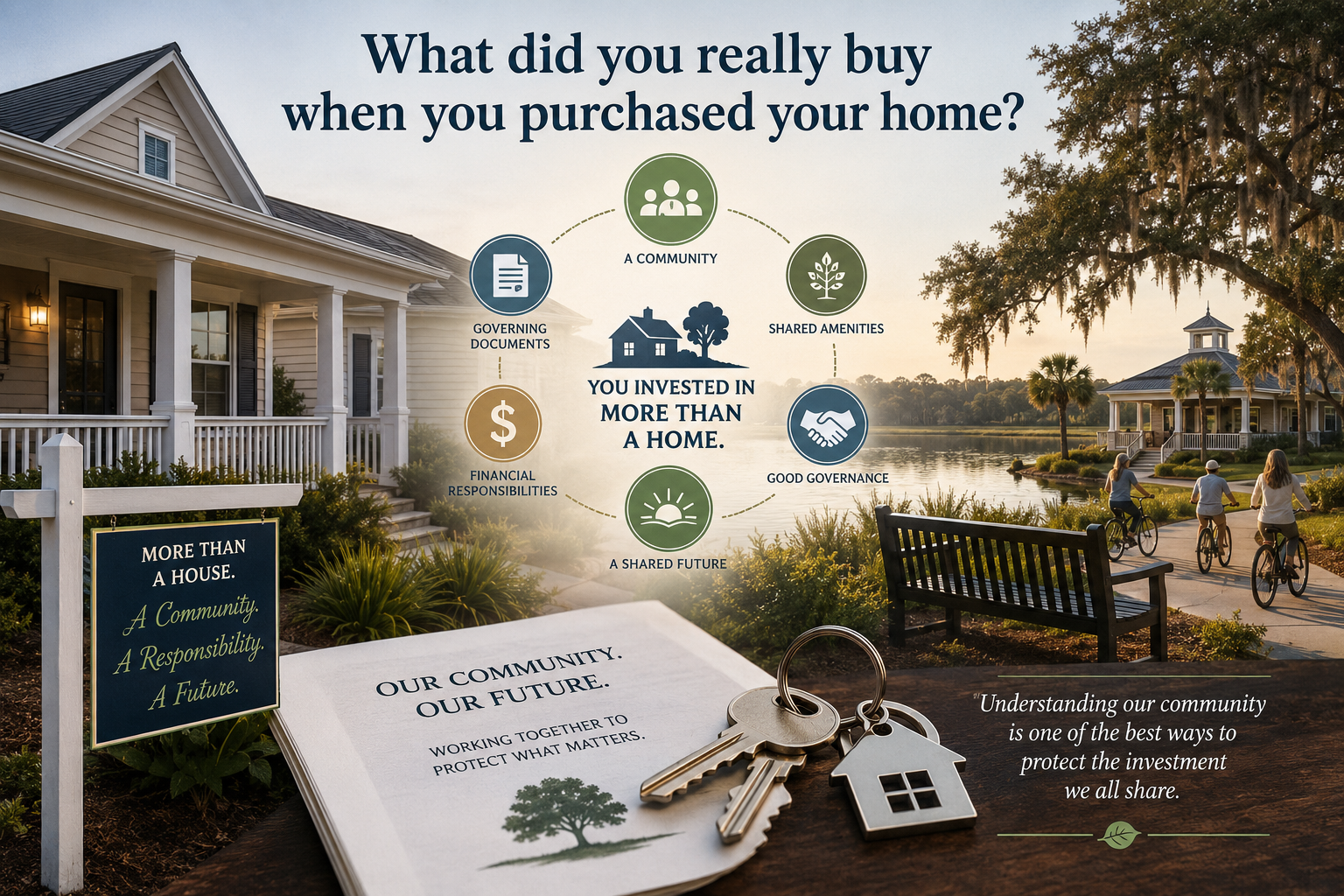
Buying a Home Is Only the Beginning
Closing day changes more than your address.
It changes your relationship with a place.
For months, the focus has been on finding the right home. You compare neighborhoods, walk through houses, review inspections, negotiate contracts, and eventually sit down at a closing table where, after a great deal of anticipation, someone slides a set of keys across the table.
It feels like the finish line.
In reality, it’s the starting point.
Because on closing day, you don’t simply purchase a home.
You become part of a community.
That’s an important distinction because communities are more than collections of homes. They are living organizations with histories, governing documents, shared amenities, financial obligations, and long-term plans. They evolve over decades, shaped by the people who live there and the decisions those people make.
Whether we realize it or not, every property owner becomes part of that story.
Of course, the home itself remains our most visible investment. We maintain the roof, landscape the yard, repaint the walls, and repair what breaks.
But there is another investment that often receives far less attention.
Every property owner also has a stake in the health of the community itself.
The condition of the amenities.
The strength of the reserve funds.
The consistency of the architectural standards.
The quality of community governance.
The long-term planning that protects what has been built.
None of these appear on a settlement statement, yet each contributes to the value of every home within the community.
That is why ownership in a planned community carries both benefits and responsibilities.
Not because every property owner needs to become an expert in association governance.
Not because everyone needs to attend every meeting or read every governing document.
Rather, because stewardship begins with understanding.
Understanding how the community came to be.
Understanding who is responsible for making different decisions.
Understanding where the community is in its own evolution.
And understanding that protecting your investment extends beyond your own property line.
Stewardship doesn’t begin when a problem arises.
It begins long before that—through awareness, participation, and a willingness to understand the community you’ve chosen to call home.
That belief is one of the reasons Coosaw Futures was formed.
Our mission is not simply to provide information. It is to help property owners better understand the history, governance, and development of Coosaw Point so they can participate thoughtfully in its future.
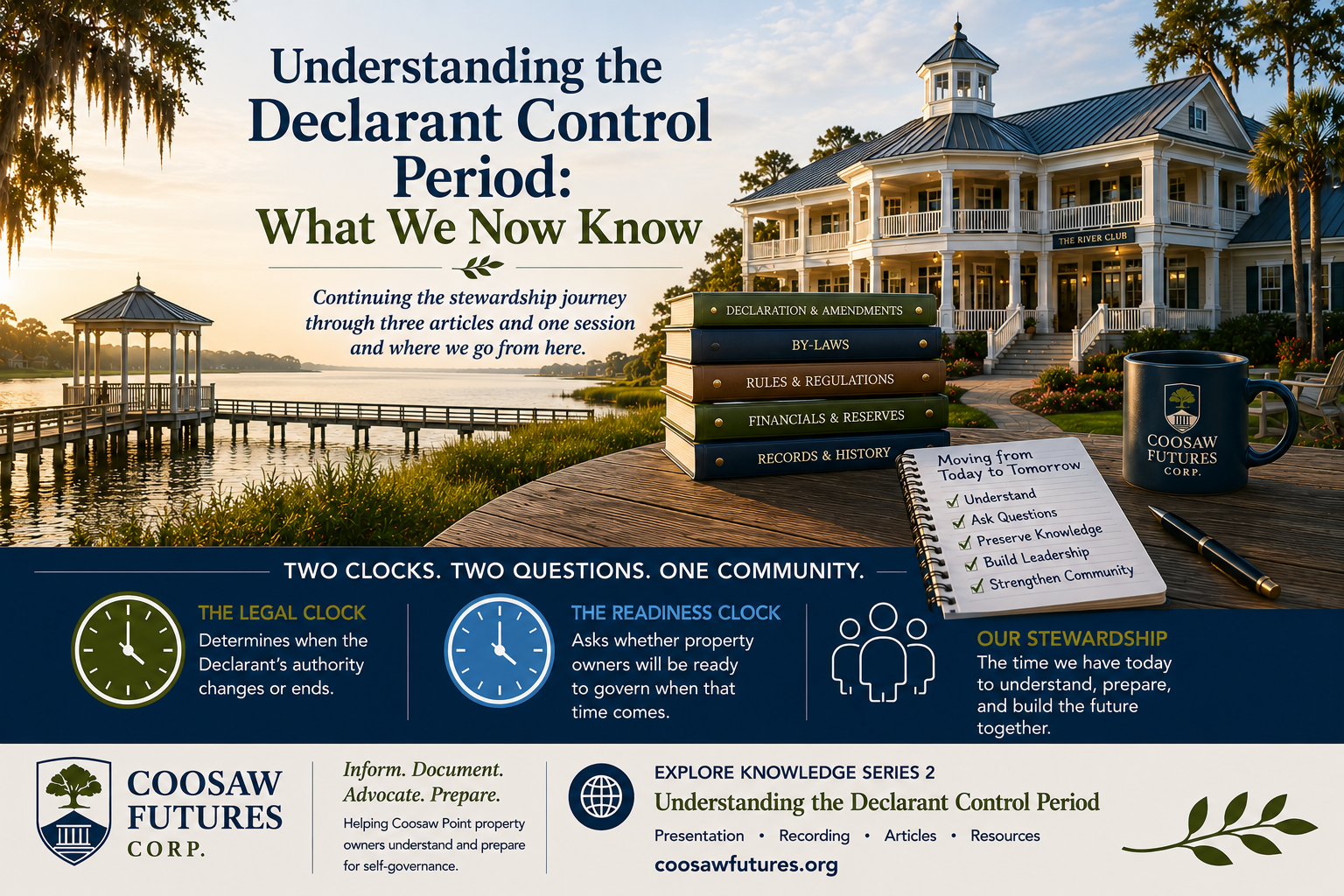
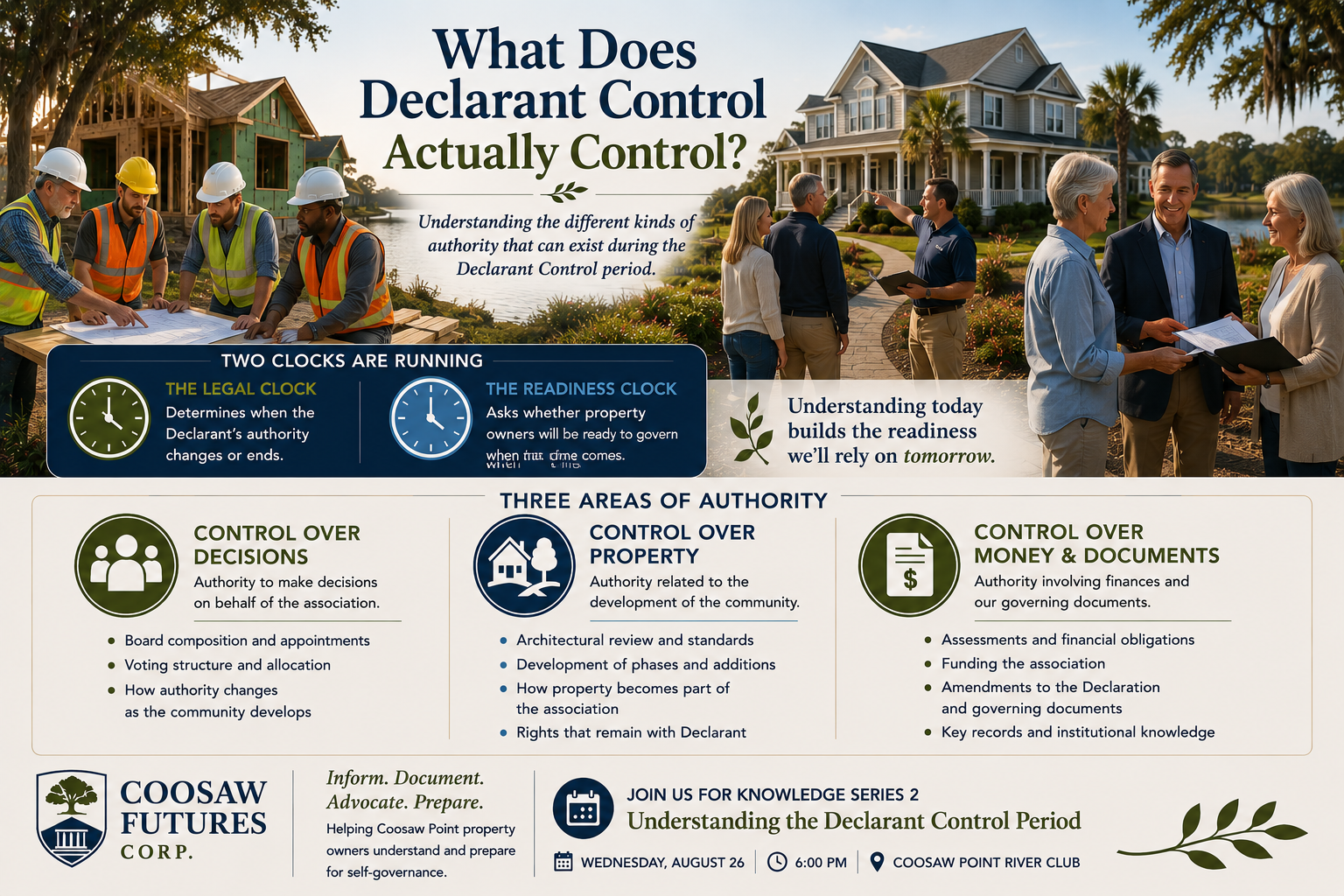
That is also the purpose of our Knowledge Series.
Each monthly session is designed to build that understanding one topic at a time. We believe informed property owners make stronger communities—not because everyone reaches the same conclusions, but because productive conversations begin with a shared understanding of the facts.
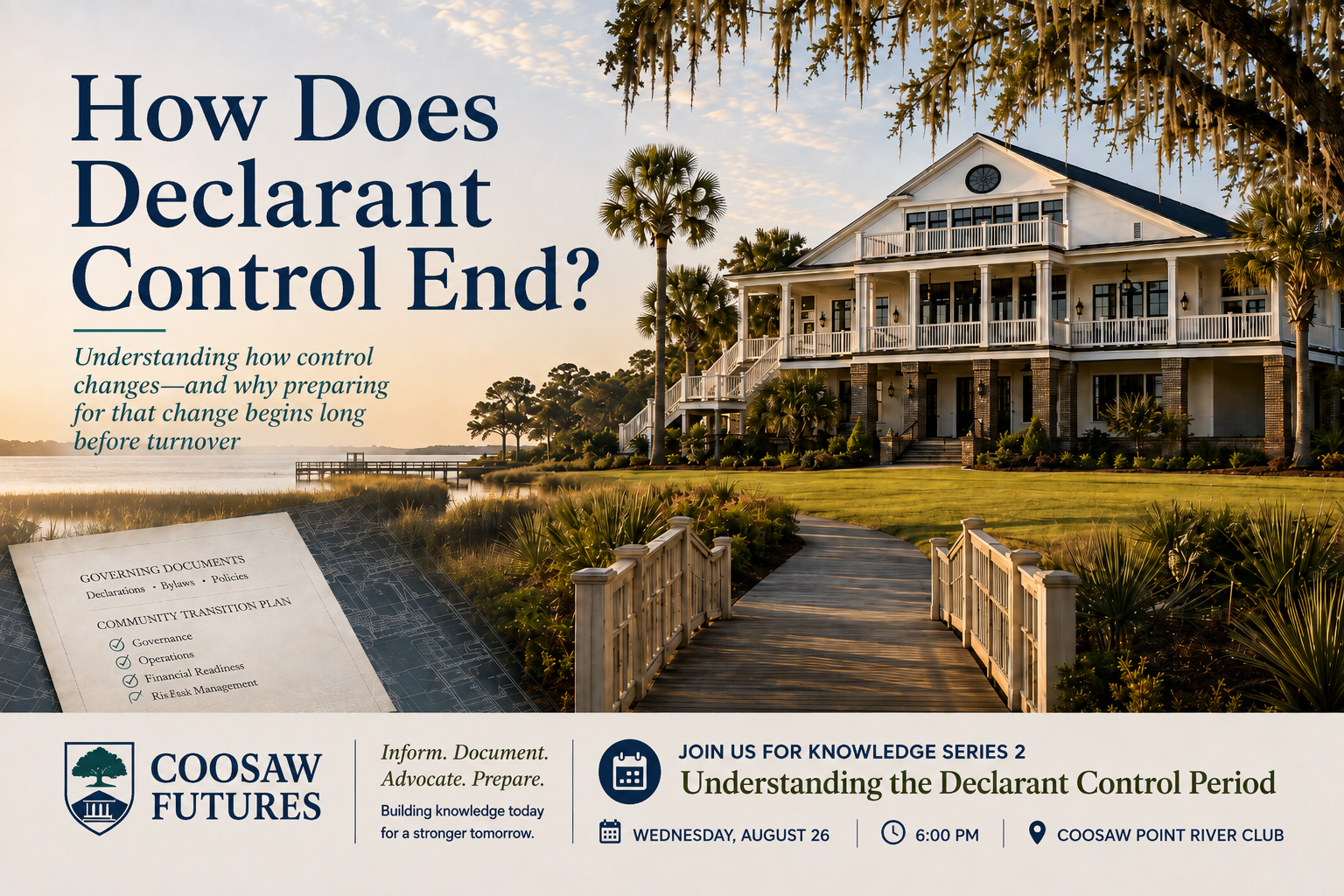
We’ll begin with Session 1: Community History & Development Structure on Wednesday, July 29, at 6:00 p.m. at the River Club.
Whether you’ve lived in Coosaw Point for years or have only recently received your keys, we hope you’ll join us as we explore the history of the community, the framework that guides it, and the shared investment that connects us all.
Before then, we’d invite you to consider one question:
When you purchased your home, did you think you were investing only in your property—or in the future of the community as well?
There isn’t a right or wrong answer.
In many ways, that’s exactly what the Knowledge Series is designed to explore.
Coosaw Futures, Corp. is an independent, owner-formed nonprofit whose mission is to Inform, Document, Advocate, and Prepare—helping Coosaw Point property owners better understand their community through education, historical preservation, and constructive civic engagement. Learn more at coosawfutures.org.

Leave a Reply
You must be logged in to post a comment.