

Communities are often viewed as if they exist in a single moment in time.
They don’t.
Like businesses, nonprofits, and even families, communities evolve. They grow, they mature, and eventually they assume responsibilities that simply didn’t exist when they began. Understanding where a community sits in that evolution provides important context for many of the questions property owners naturally ask.
Viewed through that lens, today’s discussions become less about disagreement and more about understanding where the community is in its own development.
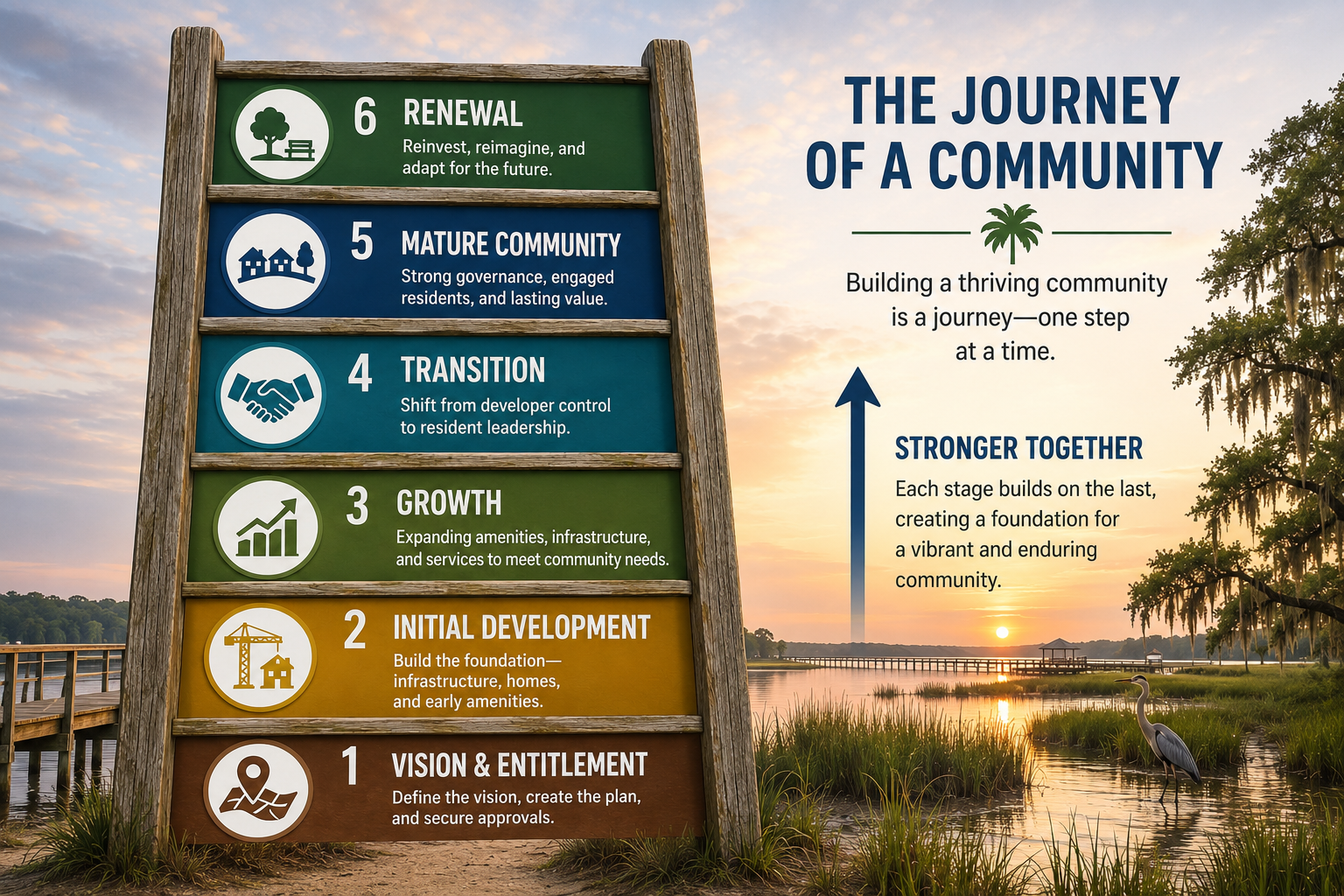
While every planned community is unique, they all tend to move through the same general progression.
1. Vision & Entitlement
Every community begins long before the first home is built. Land is assembled, approvals are obtained, financing is secured, and the master plan takes shape. At this stage, the community exists as a vision.
2. Initial Development
Roads, utilities, homes, and amenities begin to appear. Because there are few, if any, property owners, the developer necessarily makes nearly every significant decision. The focus is on creating a place where people will eventually choose to live.
3. Growth
As new phases open and additional owners arrive, the community begins developing its own identity. The Property Owners Association becomes more active, although the developer continues guiding much of the community’s direction. The community is no longer just being built—it is beginning to take shape.
4. Transition
Eventually, every successful community reaches a point where the conversation begins to change.
Owners become more engaged. Questions become more detailed. Attention shifts from building the community to sustaining it. Reserve planning, governance, long-term maintenance, and financial stewardship become increasingly important.
Some view this as conflict.
More often, it is simply maturity.
Healthy communities eventually reach a point where owners want to better understand how decisions are made, what responsibilities lie ahead, and how today’s choices will affect the future. Those questions are not signs that something has gone wrong. They are signs that the community itself is growing up.
5. Mature Community
Over time, governance increasingly rests with the property owners. The focus shifts from creating the community to preserving it. Long-term planning, responsible budgeting, infrastructure maintenance, and thoughtful governance become the foundation for protecting both the community and the investment every owner has made.
6. Renewal
No community remains static forever.
Infrastructure ages. Amenities require reinvestment. Expectations evolve. New generations of owners bring new ideas and new priorities. Every successful community eventually reaches another important question:
What should the next twenty years look like?
That isn’t the end of the community’s story.
It’s simply the beginning of its next chapter.
Here in the Lowcountry, this progression often unfolds over a much longer period than it does elsewhere. Coastal permitting, environmental considerations, phased development, and resilience planning all influence the pace of growth. A fifteen- to thirty-year development timeline is not unusual. It’s simply the way many coastal communities evolve.
Understanding that progression matters because it provides context.
Without context, normal transition-stage issues can feel unusual. With context, owners, Board members, and the Declarant have a common framework for understanding where the community is today and what can reasonably be expected as it continues to mature.
That shared understanding is one of the reasons Coosaw Futures was formed.
Our mission is built around four commitments:
Inform — Provide objective, document-based education that helps owners understand how our community is structured and where it stands today.
Document — Preserve the history and records that become the community’s institutional memory.
Advocate — Encourage informed, respectful participation in community governance.
Prepare — Help property owners understand the responsibilities that naturally accompany a mature community.
The first of those commitments—Inform—is the purpose of our new Knowledge Series.
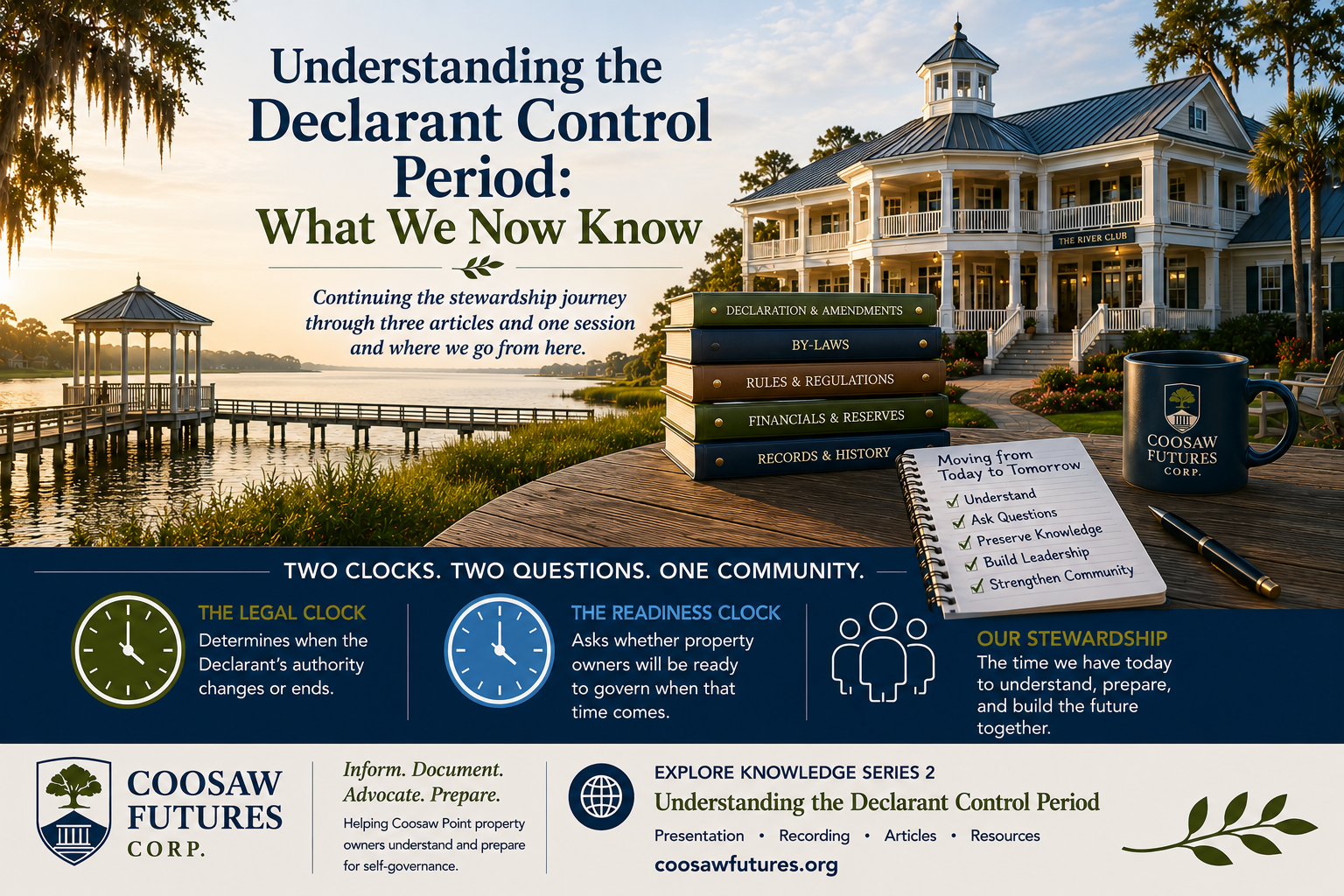
Over twelve monthly sessions, we’ll explore Coosaw Point’s history, governing documents, development structure, and governance one topic at a time. The objective isn’t to persuade anyone to adopt a particular viewpoint. It’s to provide the historical context and documentary foundation that allow each of us to better understand how our community arrived where it is today.
That naturally leads to the next question.
Where does Coosaw Point fit within this progression?
We’ll begin answering that question during Session 1: Community History & Development Structure, on Wednesday, July 29, at 6:00 p.m. at the River Club
Together, we’ll examine where Coosaw Point has been, where it stands today, and why understanding that history provides a stronger foundation for the conversations that will shape its future.
We hope you’ll join us.
Coosaw Futures, Corp. is an independent, owner-formed nonprofit dedicated to Informing, Documenting, Advocating, and Preparing Coosaw Point property owners through education, historical preservation, and constructive civic engagement. Learn more at coosawfutures.org.

Leave a Reply
You must be logged in to post a comment.