

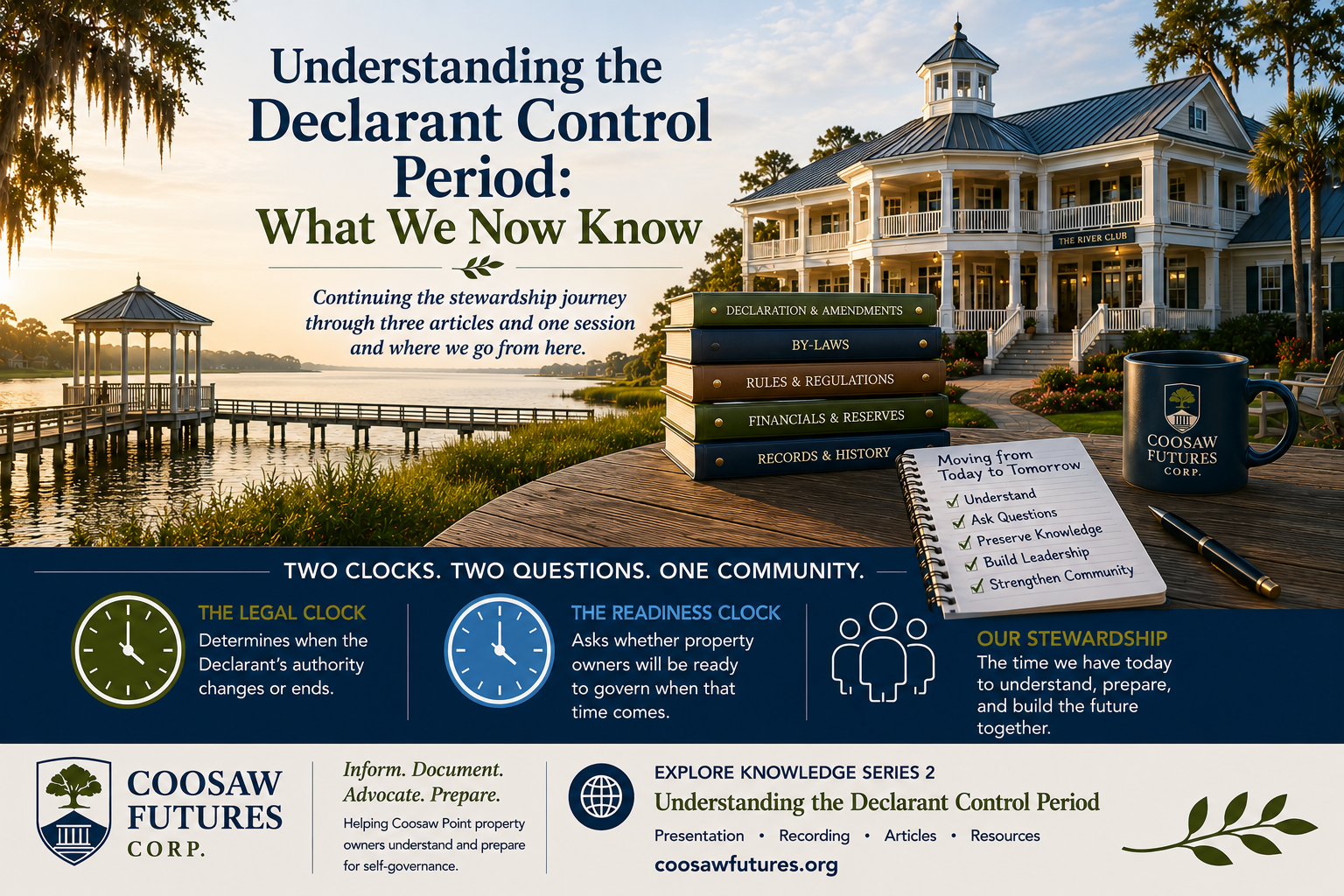
Understanding the Declarant Control Period: What We Now Know
What three articles and one Knowledge Series session taught us—and where the conversation goes next
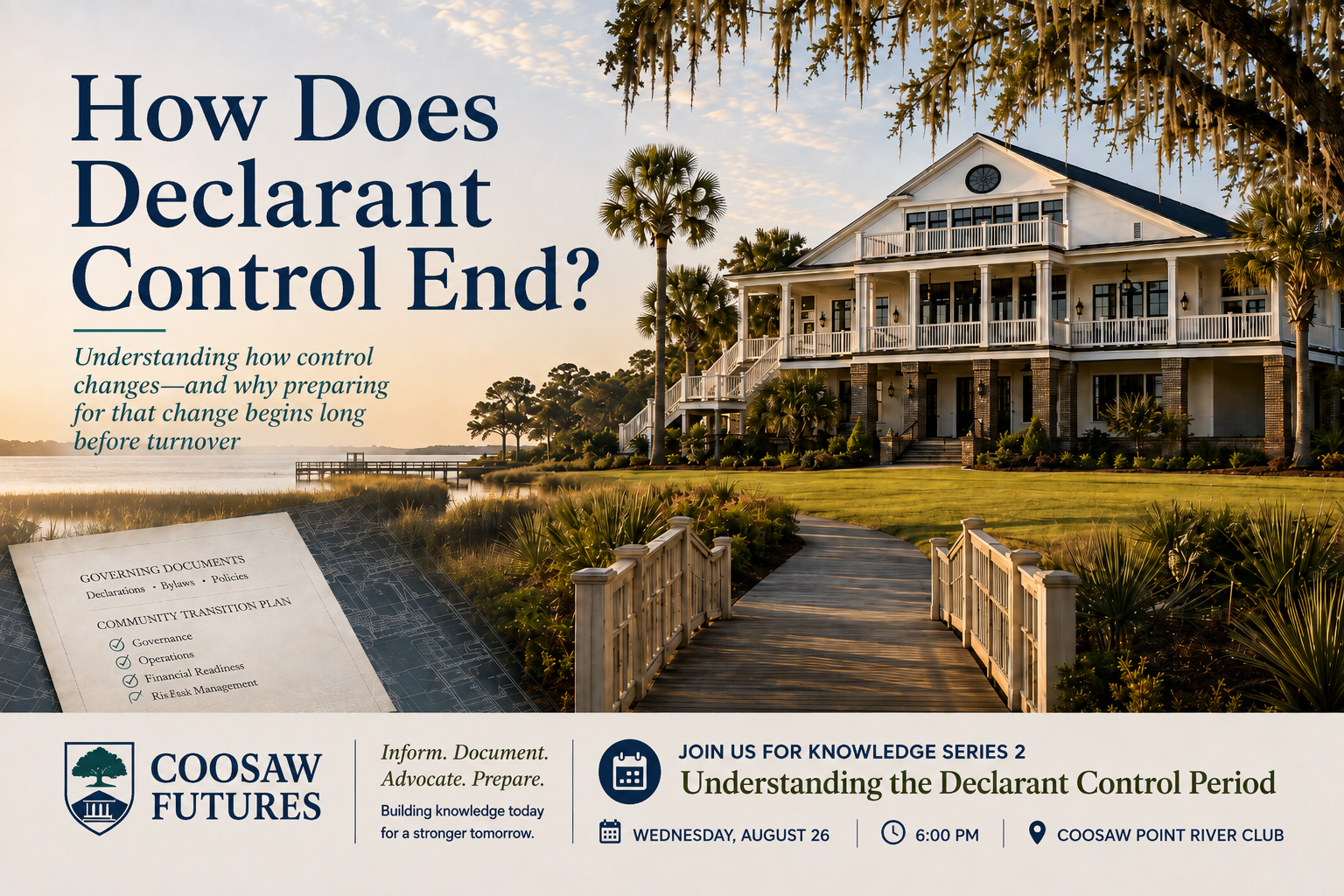
Over the past several weeks, we’ve spent a fair amount of time talking about Declarant Control. We started with a basic question: What is a Declarant? From there, we looked at what Declarant Control actually involves—the different kinds of authority over decisions, property, finances, and governing documents. Then we asked the question many property owners may care about most: How does it end?
Session 2 brought those pieces together and, importantly, moved the discussion from planned communities generally to Coosaw Point specifically. We looked at our recorded documents, South Carolina law, how Declarant rights have changed over time, and what our own Declaration says about how this period eventually ends.
Now that we’ve done that, I think it’s worth stepping back. The real value of this Knowledge Series isn’t how many provisions of the Declaration we can remember. It’s whether we understand our community a little better than we did before and what we do with that understanding.
This Stage Is Part of Our Community’s Story
Perhaps the first thing we’ve learned is that being under Declarant Control isn’t, by itself, unusual. It is a stage in the development of many planned communities. What makes it important is the amount of authority that can exist during that stage and how that authority is structured through the governing documents.
At Coosaw Point, we now know considerably more about that structure. We know that South Carolina law doesn’t establish a single timetable for when our Declarant Control period must end; our own recorded Declaration establishes that framework. We know the original Declaration provided several possible paths to ending Declarant Control and that one of those provisions, the original 15-year backstop, was later removed by amendment. We also know that development and build-out remain important parts of the process.
Those are useful facts to understand, but they are only part of what we’ve learned.
Declarant Control Isn’t One Thing
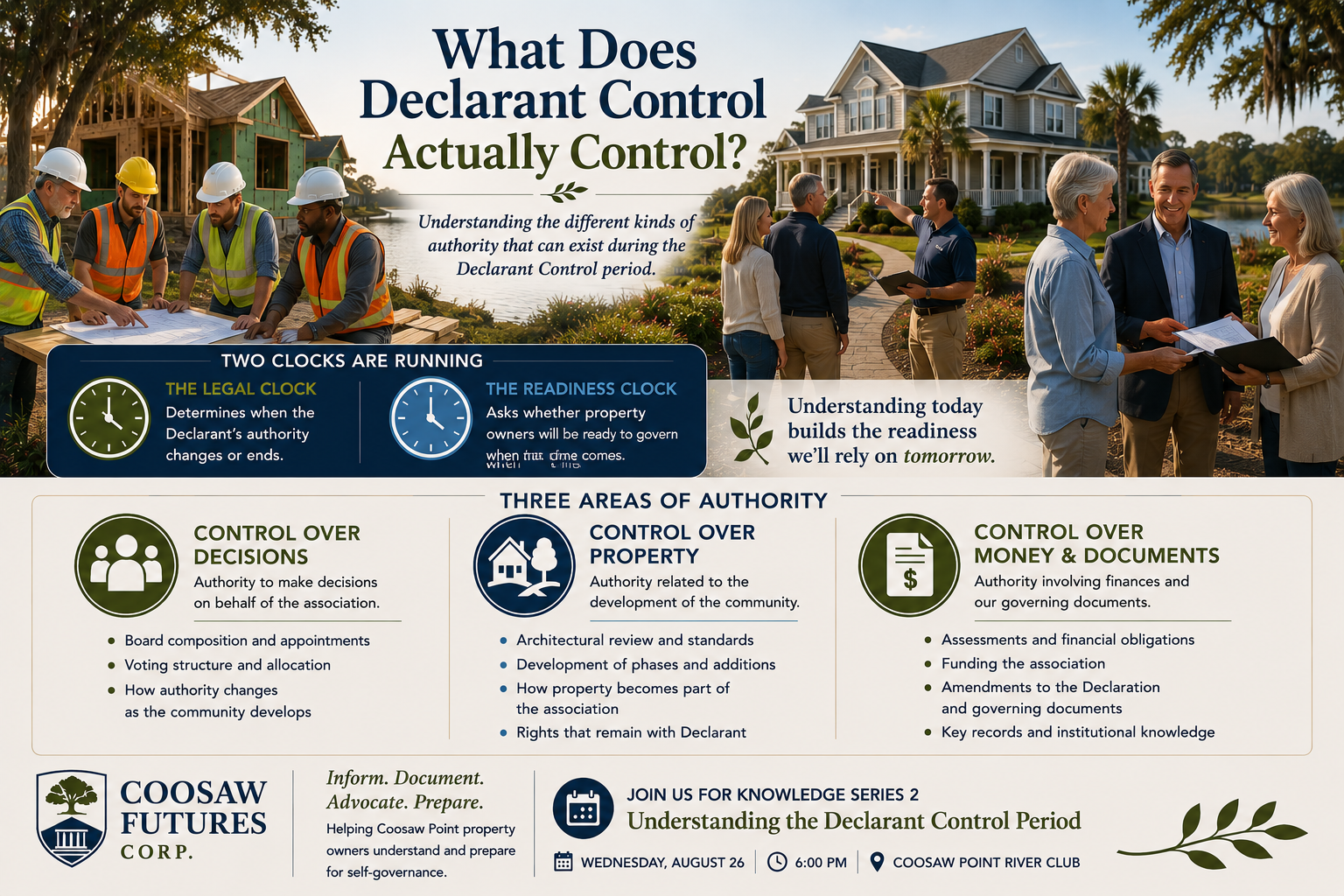
Another important lesson from Session 2 is that the phrase “Declarant Control” can make the subject sound simpler than it really is. There isn’t just one Declarant power. There are different rights involving Board appointments, architectural review, annexation, voting, assessments, amendments to governing documents, and other aspects of the community’s development. Those rights don’t necessarily work the same way or end at the same time.
I think that gives us a better way to approach questions when they arise. Instead of beginning with, “Can the Declarant do that?” we can first ask what decision is actually being made, what authority applies to it, where that authority comes from, and what our governing documents say about its limits or conditions.
That may sound like a small distinction, but I don’t think it is. It moves us from reacting to something we see toward understanding how the community actually works. That is one of the habits I hope the Knowledge Series helps us develop.
The Two Clocks—and the Role of Stewardship
Throughout this series, we’ve used the idea of two clocks. The legal clock tells us when Declarant authority changes or ends. The readiness clock asks whether property owners will be prepared for the responsibilities that eventually become ours.
Session 2 helped us better understand the legal clock at Coosaw Point. The readiness clock is different because, in many respects, we have some influence over it. We don’t control when every legal trigger occurs, but we can decide how well we use the time between now and then.
That’s where I think community stewardship becomes important.
Stewardship isn’t simply preparing for a future turnover date. It is taking an informed interest in the community we share today. It means understanding our history, our governing documents, our finances and assets, preserving institutional knowledge, asking thoughtful questions, and developing people who are willing to participate in the community’s future.
We’ve used a phrase before that I think fits particularly well here:
An investment without information is speculation. An investment with information is stewardship.
The Declarant Control period gives us time. Stewardship is what we choose to do with it.
What Does Readiness Actually Mean?
In our first article, we identified six areas that frequently matter as communities prepare for owner governance: knowledge, leadership, finances, assets, records, and relationships. I increasingly think of these less as risks and more as areas where stewardship can help build community readiness.
Knowledge means understanding our governing documents and how decisions are made. Leadership means developing people with enough knowledge and experience to eventually serve effectively on Boards and committees. Financial stewardship means understanding the association’s finances, reserves, and long-term obligations. Asset stewardship means understanding the common property we’re responsible for maintaining and what it will require over time.
The same is true of records and relationships. Preserving contracts, plans, warranties, financial information, and community history gives future leaders something to build from rather than forcing them to start over. Learning how to ask questions, work through differences, and have constructive conversations helps build the relationships a self-governing community will eventually depend upon.
None of those things needs to wait for Turnover. They are things we can work on now.
Understanding Before Evaluating
There is another lesson I hope we carry forward from this series. As property owners, we’re going to encounter decisions we agree with and others we don’t. There will be things we understand and things that raise questions. That’s normal in a community of this size, particularly one that is still developing.
But we don’t have to move immediately from seeing something we question to deciding what it means. We can take the time to understand the governing framework, gather the facts, ask thoughtful questions, and evaluate the answers before deciding what comes next.
That doesn’t mean avoiding difficult questions or disagreements. Stewardship can include accountability. It can include asking for clarity, questioning a decision, or advocating for something we believe is important. The difference is that we try to do those things from a foundation of information and understanding rather than assumption.
Over time, I think that creates something much more valuable than an answer to any one issue. It helps build a community that knows how to think through difficult questions together.
Which Brings Us to the Board
That is also where our next Knowledge Series begins.
We’ve spent Session 2 primarily trying to understand the Declarant—what that role is, what authority comes with it, and how that authority eventually changes. The natural next step is to better understand the other part of our current governance structure: the Property Owners Association and its Board.
Knowledge Series 3: POA Governance Basics will look at how the Board is structured, the responsibilities of directors, how decisions are made, how property owners participate, and how those pieces fit together. That’s not simply preparation for some distant Turnover date. Property owners already have a role in Coosaw Point’s governance today and understanding that role is part of good stewardship now.
It is also how the Knowledge Series begins to build from one subject to the next.
Knowledge Series 1 helped us understand where Coosaw Point came from. Knowledge Series 2 helped us better understand where we are today. Knowledge Series 3 begins looking more closely at how our POA governance actually works.
From there, we’ll continue into governing documents, finances, infrastructure, amenities and the other responsibilities that go into sustaining a community like ours over time.
Each subject adds another piece.
The goal isn’t to turn every property owner into an expert on every issue. It is to create a framework that helps all of us ask better questions, find reliable information, preserve what we learn, and become more capable stewards of the community we share.
A Question to Consider
Of the six areas we’ve identified; knowledge, leadership, finances, assets, records, and relationships, where do you think Coosaw Point is best positioned today? And where do you think greater stewardship could make the biggest difference?
There is no single right answer. Understanding where we are is simply a good place to begin thinking about where we want to go.
If you couldn’t attend Session 2, the presentation, recording, and related Knowledge Series articles are available through Coosaw Futures.
And watch for Knowledge Series 3: POA Governance Basics, coming on September 30 at 6pm at the Coosaw Point River Club.
Coosaw Futures, Corp. is an independent, owner-formed nonprofit whose mission is to Inform, Document, Advocate, and Prepare—helping Coosaw Point property owners understand their community and prepare for the responsibilities of self-governance.

Leave a Reply
You must be logged in to post a comment.