

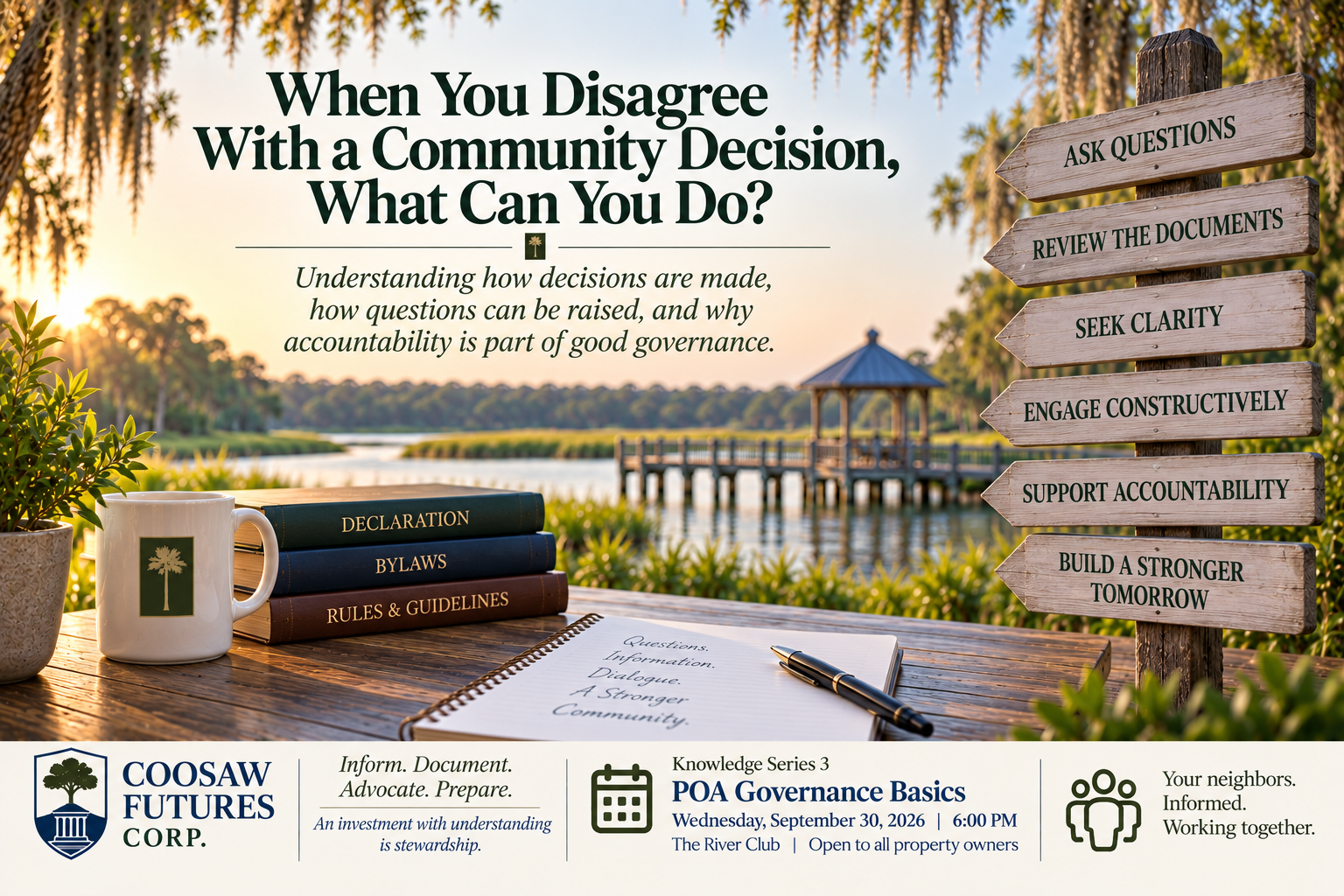
When You Disagree With a Community Decision, What Can You Do?
Understanding how decisions are made, how questions can be raised, and why accountability is part of good governance.
At some point, almost every property owner will disagree with a decision made in their community. Sometimes the disagreement is simply about judgment. The Board chooses one approach and we would have preferred another. Reasonable people can look at the same information and reach different conclusions.
But sometimes the question is different. We may not understand how the decision was reached. Important information may have been overlooked. The governing documents may appear to say something different. We may wonder whether the person making the decision actually had the authority to make it. Or a decision may simply have been made incorrectly and deserves to be reconsidered. What happens then?
I think many property owners assume there is not much they can do. If the Board, Declarant, ARB, or someone acting on behalf of the Association made the decision, then that must be the end of it. It’s more complicated than that.
Being a member of a property owners association doesn’t mean we get to overturn every decision we disagree with. But neither does it mean our only choices are accepting a decision without question or immediately turning the disagreement into a legal fight. There are steps in between. Understanding those steps is part of being an informed property owner, and I think it is an important part of community stewardship.
Decisions Have to Be Made
We talked in Blog 2 about what Board service actually involves. One of the most important responsibilities is making decisions. Some are fairly routine. Others involve competing priorities, significant money, interpretation of governing documents, maintenance of community assets, contracts, rules, enforcement, or questions about the future. Not everyone will agree with every decision.
That does not necessarily mean there is a governance problem. A Board can consider the information available, follow the governing documents, exercise reasonable judgment, and still reach a conclusion some property owners would not have chosen. That is part of representative governance.
The important question is not whether we agree with the outcome. It is whether we understand enough about the decision to know what kind of disagreement we have.
Did the Board make a reasonable decision that I happen to disagree with? Is there information that may not have been considered? Is there confusion about what was actually decided or why? Does the decision appear inconsistent with the governing documents? Was the required process followed? Did the person or body making the decision actually have the authority to make it?
Those questions take us somewhere more useful than simply saying, “I don’t agree.”
Start by Understanding the Decision
The first step is probably the simplest, but it can also be the most important.
What actually happened? That may sound obvious, but community decisions are not always communicated in a way that makes the answer clear. An email may come from the management company even though they did not make the underlying decision. A policy may be attributed to “the POA” without explaining whether it came from the Board, Declarant, ARB, or somewhere else.
This brings us back to Blog 1 and the importance of understanding which hat is being worn. Who made the decision? What authority were they exercising? Where does that authority come from? Before deciding whether something needs to be challenged, it helps to understand exactly what we’re questioning. Sometimes clarification resolves the issue. Sometimes it raises another question.
Establish the Facts
If a question remains, the next step is to establish the facts.
What do the Declaration and Bylaws say? Is there an amendment that applies? Is there a rule or architectural guideline involved? Are there minutes, financial records, contracts, policies, or other Association records that would help explain what happened?
Our Bylaws provide members with rights to inspect a significant category of Association records for purposes reasonably related to their interest as owners. South Carolina nonprofit law also establishes corporate recordkeeping and member inspection requirements. Those rights matter because good questions usually begin with good information.
There is a significant difference between saying, “I don’t think the Board can do that,” and saying, “I’ve read the provision that appears to govern this decision, and I don’t understand how the decision is consistent with it. Can you help me understand what I’m missing?” The second question creates an opportunity for an answer. It also creates an opportunity to discover that something may actually have been missed.
Sometimes a Decision Deserves Another Look
No governance structure eliminates mistakes. Board members can make mistakes. Management companies can make mistakes. Declarants, committees, professionals and property owners can make mistakes.
Sometimes an important fact was not considered. A governing-document provision may have been overlooked. A policy may have been interpreted differently than intended. Financial consequences may not have been fully understood. Someone may have acted outside the authority delegated to them.
An informed property owner can sometimes help identify those things. That doesn’t require approaching every decision with suspicion. It means understanding enough about the community to recognize when something does not appear to fit and being willing to ask the next question. Sometimes the explanation confirms that the decision was properly made, even though we still disagree with it. Sometimes new information changes our understanding. And sometimes the question causes the decision-maker to reconsider or correct something.
Accountability can change an outcome.I think that is important for property owners to understand.
From Question to Resolution
There is not one appeal process that applies to every type of community decision. The appropriate process depends on what was decided, who made the decision, and what the governing documents provide for that particular situation.
There is a reasonable progression an informed owner can follow. It begins with clarification. Understand what was decided, who decided it, and why. If questions remain, verify the facts. Review the governing documents and the records reasonably available to members. Understand the authority involved and any process that was supposed to be followed.
Then raise the question with the appropriate decision-maker. Explain the concern, provide the information supporting it, and ask for an explanation or clarification. If the information suggests that something may have been overlooked or handled incorrectly, the next step can be to request reconsideration or correction. Boards and other decision-makers can revisit matters when new information, an error, or a misunderstanding comes to light.
After that, the process becomes more specific to the issue. The governing documents may provide a hearing, membership process, voting right, enforcement procedure, architectural process, or some other mechanism. For broader membership concerns, our Bylaws also provide a process through which the required percentage of members can petition for a special meeting. And if a significant matter cannot be resolved internally, there may be outside options such as mediation, professional advice, regulatory or consumer complaint processes where applicable, or ultimately legal remedies.
The point is not that every disagreement should travel all the way up that path. Most should not. The point is that there is a path between saying nothing and immediately treating a disagreement as a legal dispute.
Clarify. Verify. Question. Reconsider. Use the appropriate formal process. Seek outside resolution when the issue truly warrants it. Knowing that path can make both owners and governance stronger.
The Other Side of Accountability
There is another side to this relationship. Property owners have a responsibility to become informed before reaching conclusions. But people exercising community authority also have a role when legitimate questions are raised. A decision may be entirely within someone’s authority and still leave owners confused about why it was made.
Explaining the issue considered, the authority involved, the information relied upon, and the reasoning behind an important decision does not guarantee agreement. But it gives property owners something more useful than an outcome alone. When a legitimate mistake is identified, being willing to reconsider or correct it should not be viewed as weakness. It is part of responsible governance.
Accountability works best when questions are not automatically treated as accusations and explanations are not treated as proof that questions should not have been asked. Both sides have a role in getting to the right answer.
Why This Matters Before Turnover
This is where I think decision-making connects directly back to the readiness clock we introduced in Knowledge Series 2. Preparing for self-governance is not just about learning what we will need to know someday. Decisions being made today can affect what property owners eventually inherit.
Financial decisions can affect reserves and future assessments. Maintenance decisions can affect the condition of common assets. Contracts can create obligations that continue for years. Records that are not properly maintained today may be difficult to recreate later. Governance practices can become established habits. Finding a problem at Turnover that began years earlier is not as useful as recognizing it while there may still be an opportunity to understand it, question it, and, when appropriate, correct it.
That’s why stewardship today includes accountability today. An informed community does not need to challenge every decision. It should have enough understanding to recognize when a legitimate question needs to be asked and enough knowledge to know what to do next. That is not opposition to governance. It is participation in governance.
Where Stewardship Fits
For me, this is where the first three articles in Knowledge Series 3 begin to come together. We started by looking at the different hats and roles involved in governing Coosaw Point. Then we looked at what it means to serve on the Board and the responsibilities that come with being entrusted to make decisions for the Association. Now we come to the decisions themselves.
Good governance requires people willing to make decisions. It requires property owners willing to understand them. And it requires a process through which legitimate questions can be raised when something does not appear right. Sometimes the answer will be that the decision was properly made and simply was not the decision we preferred. Sometimes better information will resolve the disagreement. And sometimes an informed property owner may identify something early enough that a poor, mistaken, or non-compliant decision can be reconsidered or corrected before it becomes a larger problem. That is an important check in any governance system. And I think it is an important part of what community stewardship means.
Stewardship is not preparing ourselves to make good decisions someday. It also means paying attention to how our community is governed today.
A Question to Consider
If you disagreed with a community decision today, would you know where to go to understand how it was made, what authority supported it, and what options you have if questions remain?
If the answer is unclear, that is exactly why this part of governance is worth understanding.
In Knowledge Series 3: POA Governance Basics, we will put these pieces together: the roles involved in governing Coosaw Point, the responsibilities of those entrusted with authority, how decisions are made, and where informed property owners fit when questions or disagreements arise.
Sources
Coosaw Point Amended & Restated Declaration of Covenants, Conditions and Restrictions, as amended.
Coosaw Point Property Owners Association Bylaws, as amended.
South Carolina Nonprofit Corporation Act, S.C. Code Ann. Title 33, Chapter 31.
South Carolina Department of Consumer Affairs, Homeowners Association education and complaint resources.
Community Associations Institute, Alternative Dispute Resolution public policy and community association best-practice resources.
Coosaw Futures, Corp. is an independent, owner-formed nonprofit whose mission is to Inform, Document, Advocate, and Prepare—helping Coosaw Point property owners understand their community and engage constructively as it moves toward eventual self-governance.


Leave a Reply
You must be logged in to post a comment.