

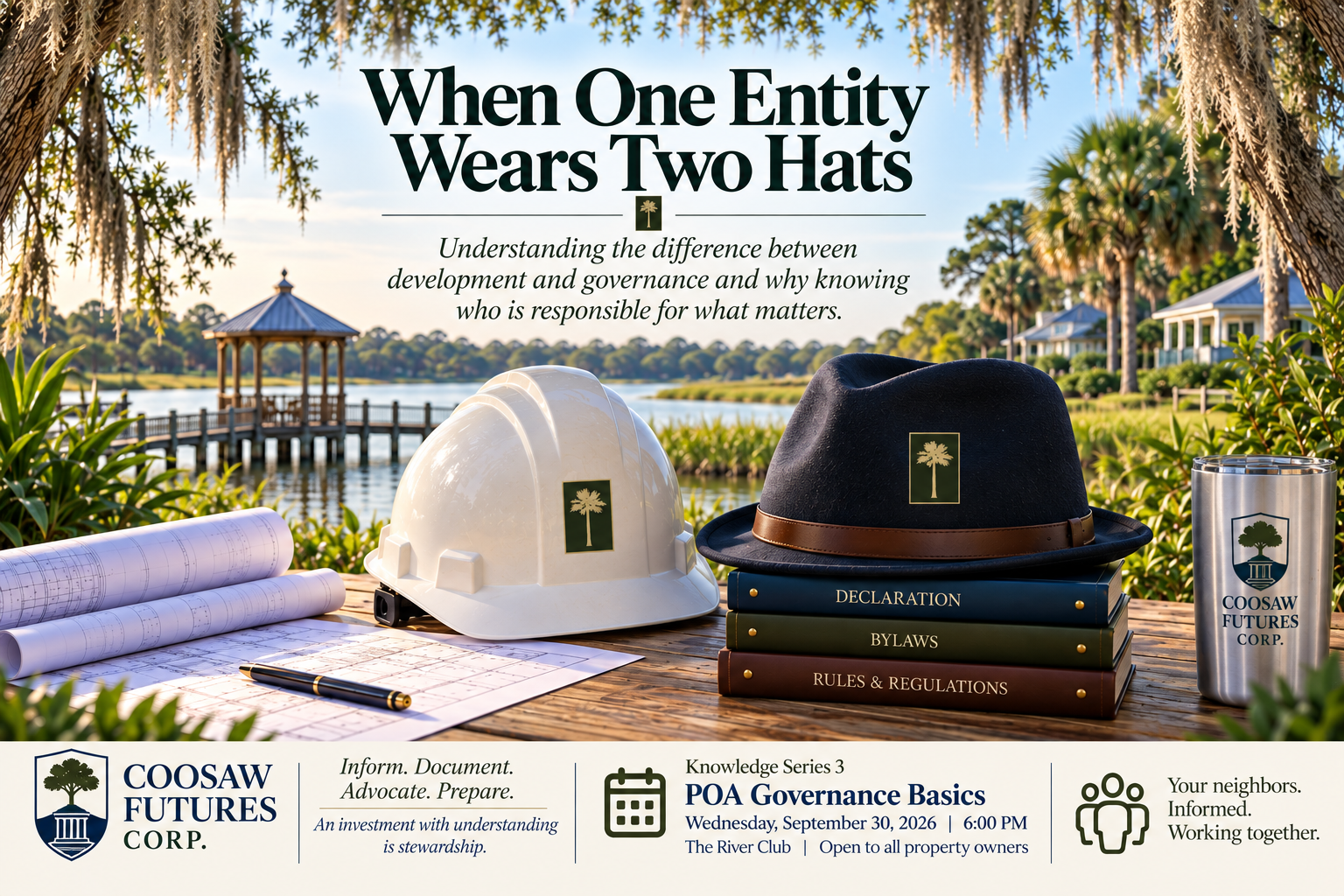
When One Entity Wears Two Hats
Understanding the difference between development and governance and why knowing who is responsible for what matters.
In Knowledge Series 2, we spent a fair amount of time looking at the Declarant Control period. We talked about why planned communities often begin with developer involvement in governance, the different kinds of authority a Declarant may hold, and how those rights are established through the governing documents.
We are not going to cover all of that again. However, there is one part of that discussion that becomes especially important as we move into Knowledge Series 3 and begin looking at how our Property Owners Association actually works.
During the development period, the same entity can sometimes be wearing two different hats. One is the developer’s hat. The other is a governance hat.
Understanding which hat is being worn, and where that particular authority comes from, can help make a sometimes complicated governance structure much easier to understand.
The Two Hats
The developer’s role is fairly easy to recognize. The developer is completing the community, developing and selling property, working through remaining phases, and exercising development rights that may continue while build-out is underway.
The governance role is different. During Declarant Control, the governing documents may also give the Declarant rights involving the Association, including Board appointments and other forms of participation or approval. We covered many of those specific rights in Knowledge Series 2.
The important point for this discussion is not to revisit the list. It is to recognize that the two roles can overlap without being the same role.
That distinction matters because the interests and responsibilities associated with developing property are not necessarily identical to those associated with governing an association. When the same entity has a role in both, understanding which hat is being worn helps us know what authority applies, what responsibilities accompany it, and where to look when we have a question.
Understanding the Framework
Understanding why this structure exists is only part of the picture. It is just as important to understand the responsibilities that come with each role and the framework within which that authority is exercised.
Some of that framework comes from South Carolina law. Much more of it comes from the community’s own governing documents, our Declaration, Bylaws, recorded amendments, rules and architectural guidelines. Those documents do not just tell us who has authority. They also help us understand what kind of authority it is, how it is exercised, and where its limits may be.
That distinction becomes especially useful when a question arises in the community. Is this a Declarant decision? A Board decision? An ARB decision? Is the management company making the decision, or simply carrying out a decision made by someone else?
Knowing which hat is being worn helps us know where to look for the answer.
Who Is Actually Making the Decision?
That leads to what I think is one of the more useful habits we can develop as property owners. When something happens in the community, we should first understand who is actually making the decision.
It may be the Declarant exercising a right reserved under the Declaration. It may be the POA Board exercising authority given to it under the Declaration and Bylaws. It may be the Architectural Review Board acting within its particular responsibilities. Or it may be the management company carrying out something it has been directed or contracted to administer.
Those distinctions can easily get blurred. When a property owner receives a communication from the management company, for example, it can be natural to assume the management company made the underlying decision. Sometimes it may simply be communicating or administering a decision made somewhere else.
The same can be true when we use broad terms such as “the POA,” “the Board,” or “the developer.” Those terms can describe very different roles depending on the issue. Before we can evaluate a decision, or even know where to direct a question, it helps to know who actually had the authority to make it.
Responsibility Follows Authority
There is another side to understanding authority that I think is equally important. If someone has the authority to make a decision on behalf of the Association, there are also responsibilities associated with exercising that authority.
That becomes particularly important when we talk about the Board. Coosaw Point’s Board today includes both Declarant-appointed and property owner-elected directors. How someone arrived at the Board table may be different, but Board service carries responsibilities associated with the Association. Our governing documents address the standard under which directors are expected to act, as well as the responsibilities entrusted to the Board. We will spend more time on that in this series.
This is where the discussion begins to move beyond organizational charts and titles. Governance is not simply about who has the authority to make a decision. It is also about how that authority is exercised and the responsibilities that come with it.
For property owners trying to understand how their community works, both questions matter.
Where Does the Management Company Fit?
The management company is a good example of why understanding roles matters. A professional management company can be very visible in the day-to-day life of a community. It may handle communications, financial reporting, owner requests, architectural submissions and other administrative functions. Because owners interact with management frequently, it can sometimes appear to be the governing authority.
But the management company is a contracted vendor to the Association, not itself a governing body. Its authority comes from what has been delegated to it. That is an important distinction in Coosaw Point’s current structure and one we will explore more fully in Session 3.
Knowing that helps us ask a better question when an issue arises: Is management making this decision, or is management carrying out a decision or policy established by someone else? Again, knowing the role helps us know where to look for the answer.
Where Do Property Owners Fit?
This may be the most important part of the structure for us to understand. If much of the formal decision-making authority during Declarant Control rests elsewhere, it can be easy for a property owner to wonder what role we actually have. If we do not make every decision, does our participation really matter?
I think the answer is yes, although our role today is different from the role property owners will eventually have.
Property ownership gives us membership in the Association, and membership carries rights and standing under our governing documents. Owners elect some of today’s directors, participate in the membership processes provided by the documents, receive information and notices, ask questions, raise concerns, and have an interest in understanding how Association decisions affect the community. Session 3 will look more closely at those rights and how they operate during Declarant Control.
But I don’t think an owner’s role in governance should be measured only by the number of votes we control.
Informed owners provide another kind of check. We can understand the documents, follow how decisions are made, ask where authority comes from, request information when appropriate, question something that does not appear clear, offer experience and ideas, and hold those exercising authority accountable to the responsibilities that come with it.
That does not mean every question changes a decision, and it does not mean every disagreement indicates something is wrong. It means governance works better when the people affected by it understand enough to participate thoughtfully.
There is also a longer-term reason this matters. Today’s property owners are where tomorrow’s Board members, potential committee members and community leaders will come from. If we wait until Turnover to begin understanding how the Association works, we will have waited too long.
Owner participation today is therefore about more than influence over a particular decision. It is also how we begin developing the knowledge, experience and relationships that self-governance will eventually require.
Why This Matters for Stewardship
That brings us back to community stewardship. Stewardship does not require every property owner becomes an expert on our Bylaws or understand every operational detail of the Association. It means having enough understanding of the structure to know how our community works, where decisions are made, where to go when we have a question, and how we can participate constructively.
It also means recognizing that authority, responsibility and accountability belong in the same conversation.
Some responsibilities are exercised by the Declarant today. Some belong to the Board. Some functions are delegated to management. The ARB has a particular role. Property owners have a role as members as well. Over time, that balance will continue to change.
The more we understand those roles now, the better able we are to participate thoughtfully today and assume greater responsibility tomorrow.
That is part of stewardship too.
A Question to Consider
When you think about how Coosaw Point operates today, is it clear who is responsible for a particular decision and where property owners fit into the process?
If the answer is not always clear, it is exactly why this is worth understanding.
In Knowledge Series 3: POA Governance Basics, we’ll begin putting those pieces together: who does what, where authority comes from, what responsibilities come with it, how decisions move through the community, and how property owners participate in the process.
Sources
Coosaw Point Amended & Restated Declaration of Covenants, Conditions and Restrictions, as amended.
Coosaw Point Property Owners Association Bylaws, as amended.
South Carolina Nonprofit Corporation Act, S.C. Code Ann. Title 33, Chapter 31.
Coosaw Futures, Corp. is an independent, owner-formed nonprofit whose mission is to Inform, Document, Advocate, and Prepare—helping Coosaw Point property owners understand their community and engage constructively as it moves toward eventual self-governance.

Leave a Reply
You must be logged in to post a comment.